Monday, 5 May 2008

Oh, god.


Did anyone else feel like staying in bed this weekend? Did anyone else struggle with basic tasks like shaving and making the tea? Did anyone hesitate before opening the papers or firing up the net?
It was so fragile. Just for a little while longer, we could pretend that it had all been a dreadful booze-fuelled nightmare and all we needed was a quiet day with the curtains closed and we'd be fine. But it's Monday morning, now, and the Tories have still got the councils. There's still a fucking BNP member on the London Assembly. And by 140,000 votes, smug Tory clown Alexander Boris Johnson is now Duke of London and spoilt Prince of the underground. We start this clammy May week in a country that has lurched drunkenly to the right: get the resolve from the cupboard. It's going to be one hell of a hangover.

Look at him. Look at his terrible pink face. On the BBC's post-victory interview, the BNP's second-choice candidate began to reveal his true colours. No more the bumbling, Bertie Wooster-esque gaffe-happy clown, oh no. Someone's been training him. Only his eyes and mouth moved, lizardlike, apart from occasional forays into the tantrumish rage of a small toddler when the BBC interviewer asked if he could call him 'Boris'.

He was obtuse, he interrupted, was massively self-satisfied and oozed privilege. He repeated over and over again 'how much he had wanted to win,' and now that the Blond has squealed and cajoled us into giving him what he wanted, we're about to find out if he really has any useful policies beyond 'Boris for Mayor'.

The BNP back the Blond for some very good reasons: he is uncomplicatedly racist, a misognyist, a snob, an elitist and a hard-line right-winger who supported the Iraq war from bloodshed to bloodshed and condemns gay marriage in the press. His reactionary and disgusting views are indulged because apparently he's a cheeky old diamond in the rough, a people's politician who's not afraid to speak his mind. Festering bollocks to that one. Those who remember Enoch Powell and his rivers of blood will recall that just because someone's openly racist and sexist does not mean they're not a swindling, duplicitous bigot.

Enough of this. We KNOW all this. What we don't know yet is what we're going to do about it. We've got years of struggle ahead of us without the reassurance of the Labour back benchers when we criticise our government. We may not have a decent and dignified left-wing politician in charge of the capital. We may be terrified at the prospect of our country slipping slowly and inexorably towards the right, but this is what happens when people lose faith in democracy. We use it to self-sabotage, to elect bigoted leaders greedy for control and we roll over to call the fuckers 'uncle'. And it's not that they don't believe in equality, of course, but some politicians - politicians like Boris - believe that some animals are more equal than others.

On this clutch of islands, we do not stand and applaud when party leaders enter the room, but Alexander Boris De Pfeffel Johnson, who has Prime Ministerial ambitions, almost certainly sees himself as that sort of politician. He wants to be in charge, and his own power is his highest political ideal. I remain on bloody tenterhooks to see what the hell he's going to do with that power now he's got it, but for whatever it's worth, be assured that my comrades and I will be keeping a very close eye on City Hall over the coming months. Look forward to exciting and relevant new blogs, city-wide activism in the face of the Forward Intelligence Team's bullying, anti-capitalist drunken ranting and possibly an album of radical folk songs. Goshdemnit, but we're going down shouting.


Friday, 2 May 2008

Election feverdreams....

London on election night. You could knife the air, and not just because I live with drug fiends. The BBC have no exit polls. Sky have no exit polls. 'Neutral' news sites are sensationalising with vox pop polls and rabid speculation. Selective members of the insomniac left are fretting and snarking at one another, having devoured all online content and gone shocking like the little robot in the Short Circuit films.

Input....? Input....?Input.....?

It's the eye of the storm, and I don't like it; my Jewish half longs to shrug and toss it all in, my Catholic half is waiting for a stained-glass miracle, and my lizard brain just wants to get under its rock. At least, it seems, the votes are being counted under the supervision of nice, normal people who sleep nice, normal hours. They're starting after breakfast at 9, reckoning that the count will take nine hours; including breaks for elevenses and afternoon tea, we should know in time to douse ourselves in valedictory booze before the pubs shut. I'm going to a party in Hackney with pagans, bisexuals and the variously depraved, and if Johnson wins I may not come back.

Which is a lie, of course. I love this city and would love it even mismanaged by a racist Tory clown; I'm here to stay, and if the GLA lurches to the right I'll be there among the hundreds standing in its way. Let's get a good night's sleep. We might need it.

Thursday, 1 May 2008

Mayday Socialist Feminist stomp!


A very merry M'aidez to you all. I was asked to give a speech, yesterday, at the Housmans Bookshop in London. This is an extract from what I said, and my thoughts have been formed by a detailed debate over at my personal blog.
********************

A sea-change is taking place in contemporary feminism, particularly in the cities. Feminism is moving out of the universities and back onto the streets, as women of all backgrounds realise that practical action, class agitation and the rights of ordinary, working women are, and always have been, the future of the movement.
Midway through writing this article on Monday, I had a pregnancy scare. My period was a couple of days late, I was spotting but not cramping, I was off my food… I panicked.
It didn’t take me long to decide that I would want to terminate the pregnancy, and that meant a litmus test for my socialism: should I spend my limited savings, money that could be going towards vital schooling, on a quick, safe, private abortion, or should I go through the stress and psycho-physical trauma of asking for an abortion on the NHS?Fortunately I got the familiar fisting cramps that night and was soon happily curled around a hot water bottle, but by that time I’d learned two things: one, that abortion and reproductive rights, like so many other feminist concerns, are primarily questions of class and economics. Two, that when you’ve had a pregnancy scare, ‘Alien 2′ is not the film to watch to calm yourself down.
Abortion is a class issue. My organisation, Feminist Fightback, is currently lobbying and demonstrating in protest at the abortion rights retractions currently on the Commons table as part of the Human Fertilisation and Embryology Bill, which would cut the time-limit on later-term abortions.
This will not affect rich women, who have always been able to access abortions when they wanted them. It will affect vulnerable women who have no choice but to throw themselves on the mercies of the NHS postcode lottery and pray that they get a short waiting list and two pro-choice doctors.
Germaine Greer said, in her introduction to the Female Eunuch, that she could only speak about women of her own age, class and background. Very worthy, one might think, apart from the small fact that it was a blinkered, heinous and lazy approach that meant that one of the most influential political books of the decade only mentioned middle-class, educated, white women with prospects similar to Ms Greer’s.
Young feminists today are realising that in order to further our cause we must look beyond our own experiences. An extremely bright young working-class woman told me yesterday: “Rightly or wrongly, I regard feminism as it exists today as the territory of university-educated middle-class women with the privilege of spending some of their time debating privilege.”
While I would never dream of arguing that feminist theory, feminist blogging, etc is anything but worthwhile, to somebody whose concerns, through economic necessity, are more about finding and maintaining a job that will support them it cannot help but seem alien, or even irrelevant. The mainstream feminist collective appears not to care particularly about the realities of life as a working-class woman ‘
That, thanks to the oversights of Greer and her ilk, really is how feminism has come to be seen in many circles, despite the fact that it is fundamentally a socialist issue that transcends class. But that is changing, and I don’t think it’s an accident that it’s changing now.
Young women today, whatever their background, are finding themselves more socially and financially unstable than they have been for generations. As well as being more independent, we’re more likely to enter adulthood with massive amounts of debt, we face more pressure and competition to do well, our options and finances are more precarious, and we are more likely, whatever our level of education, to end up in hard graft, minimum wage jobs, as opposed to the glittering careers and model family lives so many of us were told to aim for.
This is part of what puts us in a position to empathise and share concerns with working women more than, perhaps, our mothers did. We are also aware, as 21st-century women, what it means to overwork for little reward within a patriarchal capitalist system that is fundamentally opposed to feminine needs.
After the social mobility of the mid-century, young women are finally coming to realise once more that the simple fact of being female puts our work, our capital value, on a different semiotic scale from that of our male classmates. For all of these reasons and more, feminism is turning again towards socialism as its natural counterpart, spearheaded by enterprising new groups like Feminist Fightback making links with workers organisations and trying to join forces with the dispossessed.
This isn’t about posh girls flirting with communism because they don’t want to pay their taxes.
We have no right to take control of someone else’s issue, no right to stomp into a territory we might not fully understand with our big mostly-white middle class feet. What it is about is people who’ve been lucky enough to have greater social opportunities and a platform using those opportunities and that platform to advance the cause of working women and to recognise that as women and as workers our goals are the same.
And then - crucially - it’s about making space on that platform and space in that debate for working-class women, women who may be bringing up kids alone, who may be working too many hours on minimum wage and may not have time or energy to blog or to organise direct action.
This is going to mean that middle-class feminists face the daunting task of working for change without the moral high ground, which is something that we are traditionally bad at. But we do not need the moral high ground to be agitators. Instead of ignoring our privilege, and by definition the concerns of the less privileged, we need to start using the advantages we’ve been given to form links, pursue local action and work for change, without necessarily expecting to be thanked and lavished with praise.
Like the men who helped push women’s suffrage through parliament 80 years ago, like the whites who marched with Luther King in the sixties, we have a duty to give help where we can, and then to step aside.

Friday, 25 April 2008

Binge nation pt 2: a scuffling retraction....


My, what a can of worms. If I’m not willing to admit I’ve messed up occasionally, then this blog and all of my journalism is just wanking; so, my last post, which was accused of ableism and fat-bashing, was poorly explained and based partly on navel-gazing personal experiences of bulimia and anorexia, and has been duly edited down. Now, let me try to explain better:

Eating disorders are mental illnesses generated by personal and, to some extent, political disempowerment. They are reactions against an erroneously-perceived inner grotesquery: a feeling of being out-of-control, shameful, ugly, powerless and ‘fat’ as a cipher for all of those feelings.
It is fascinating, therefore, that a white, rich, middle-aged man who has held a high-profile public office and is famous – pretty much the defininition of empowerment in western culture – has suffered in relative silence from the same disorder for twenty years. Prescott represents and embodies a violent, headily consumerist political overculture – not because of his weight, but because of his conduct – and even he is suffering undeservedly.

It was this passage that drew the most criticism:

‘John Prescott represents everything every eating disordered person is frightened that they are personally: grotesque, violent, out-of-control, self-indulgent saddled with enormous responsibilities that they did not earn, and as if to symbolise it all, obese. Every bulimic, anorexic and bulimarexic thinks that this is what they are like on the inside.’

Yes, the language is vile. This is because the concept is vile. This vileness is what obesity symbolises for the eating disordered, and it’s a violent, painful way of turning that horror inwards. I have been deep down into the bulimic mindset and that feeling of inner foulness and grotesquery is despicable, choking, so deeply fucked-up that even now, three years later, I’m sitting at my rickety kitchen table with snotty tears rolling down my face. Bulimia, all eating disorders, are dreadful, and I reacted with aggreived consideration against a cultural sickness that I once internalised like so many others, and now see everywhere around me.

I can’t help but see a link between the feelings of grotesquery associated with eating disorders and the literal grotesquery of corrupt officials and white male consumerist hegemony. The medical profession is fairly unanimous that sufferers of eating disorders and other addictions are responding to external pressures and frustrations – both individual and cultural pressures. Unable to control their personal and political circumstances, bulimics turn that controlling impulse inwards. It is therefore highly indicative that a man like Prescott, who seems to embody that violent overculture, also has to fall back on disordered and dreadful coping mechanisms to deal with himself and with his job.

I have known so many fine, beautiful, thoughtful, talented young men and women cut down by eating disorders: confused, disenfranchised, bewildered by the ridiculous demands of a grotesque and hostile hypercapitalist culture, many of them –male and female - reacting to the increased demands of forced feminisation and gender fascism. The fact that some of the very people complicit in enforcing the overculture – people who, like Prescott, necessarily take on some of the characteristics of that culture –have turned to the same terrible methods of stress control should tell us a lot about how fragile the whole system is.

There is a lot of ugliness and violence out there, and one of the worst parts of recovering from bulimia - apart from the shame, the self-disgust and the terrifying weight gain –is that you start to see that ugliness and violence outside of yourself, in a political and ideological sense, rather than internalising it.

But the fact that our political leaders suffer in the same way tells us that there is no conspiracy going on here. Nobody has forced a grotesque hypercapitalist overculture on us: we have all sleepwalked there together, and even the most powerful cannot deal with its demands. And if we can sleepwalk there, we might just be able to stumble back.

Thursday, 24 April 2008

The face of power in a binge nation


John Prescott has made eating disorders news again by coming out as bulimic. This, of course, is a perfect opportunity for me to lash myself to my favourite look-at-this-damn-issue-flogging horse. Eating disorders need celebrity chic to be news these days, but they don't cease to be a dangerous epidemic when someone famous hasn't just bared their soul in a lucrativebook deal. The thousands of brilliant young, and not so young people who are killed or mentally crippled by bulimia, anorexia, bulimarexia, binge-eating and other disorders every year fail to make regular headlines for one reason only: it's a 'girl's illness.'

This is a deeply feminist issue, of course. Although eating disorders are not, in fact, a 'women's problem' -10% of those afflicted are men and boys - is is a highly feminised disease in western culture, not helped by the fact that women and gay men make up the majority of sufferers, and this has everything to do with how it is handled by the state and press. Much was made of Naomi Wolf's erroneous statistics in 'The Beauty Myth', but she used them to make the very salient point that if an equivalent number of men and boys were suffering -even the real statistics, as the charity Beat "currently believes the number of people receiving treatment for anorexia or bulimia in the UK to be near to 90,000, while many more people have eating disorders undiagnosed, in particular those with bulimia nervosa" -there would be a national public health outcry, rather than a series of intermittent media farts.

Prescott having the disorder strikes a violent, on-air media punch of representation for the thousands of men whose lives are destroyed by the disease, and for that one can be reasonably grateful. Prescott does not merely 'represent a sick society', though. He was actually in power, actually helping to build and shape that society. It stuns me that the effect of Prescott's bulimia nervosa upon his role as a key political agent has barely been questioned. For myself, it was only after winning my 6-year battle with anorexia that I was able to properly engage with political power again, as a radical writer and an activist. This is because you cannot engage effectively with outer, political space when all your energies are being focused on fighting interior, emotional battles.

And this is perhaps the most worrying part of the Prescott affair: the fact that we have just been told that government was until not so long ago partly run by a politician who was deeply affected by a serious, chemically addictive mental illness, but because it's 'a girl's disease' that's somehow unremarkable. Charles Kennedy was only third-party leader and he was eventually forced to step down over his alcoholism, but because it's a a feminised concept, nobody takes bulimia nervosa seriously. In fact, it is one of the most physically dangerous psychoses, with a 5% mortality and 20% permanent relapse rate. But noone has yet questioned whether those years of nightly binges, vomit-swollen cheeks and emotional disturbance affected the former deputy Prime Minister's ability to govern during the years of the Iraq invasion. It's 'a women's disease' - of course it didn't affect his mental robustness, not a gruff old bulldog like Prescott!

All this talk has made me hungry, so I'll go and make dinner and muse on this more. If you, too, see John Prescott in the mirror from time to time, don't hesitate to call this helpline.

Monday, 21 April 2008

Ask a Feminist...

Have you got worries?
Are you struggling to deal with the hefty demands of modern womanhood?
Are you unable to sleep in patriarchal space?
Are you exhausted from supervising the intricate gender fuckeries of your friends, family and pets?
Are you probed by Margaret Thatcher in your dreams?


Help is at hand, as Pennyred turns feminist agony auntie. Post your woes, rants and distressed frothings in the comments, or email to laurie.penny@gmail.com and my secretary will deal with you, once he's finished ironing my thongs. Replies shall be swift and terrible.

Friday, 18 April 2008

These people are sometimes allowed guns.


Back in the meatspace I'm now a journalism student, and I learnt something very interesting at hack school today:

You do not fuck with the police.

No, really.

See, if you're a journalist, you can say whatever you like as long as you can prove that it's true. And there's the catch. If the person you've got, say, a corruption story on can cast any doubt at all over the absolute truth of your claim, you're going to have to pay them a lot of money in the civil claims court. Especially if they're rich, determined and have good representation. The Metropolitan police have the best lawyers in the country, the Police Federation, and a whole lot of litigation money -so unless you have a lot of sweet, sticky DNA-flavoured evidence in your hands, you and your paper are going to be bankrupt fairly soon.

And not that the police are ever brutal, bullying, thug-like centurions with over-inflated impressions of their own personal power, but if they ever did behave in such a despicable way, it would be incredibly difficult to prove. If someone gets beaten up in the cells, you'd better have a signed and dated testimony, not to mention copies of all their medical records, or no editor will risk going to press. If someone gets arrested without provocation - you'd better have dated, traceable photos, or you're going down.

Normally the trick to get around this is simply not to name the people you're accusing. You'd say 'officers at Hackney central station' or 'A WPC from Guildford'. However, there's a sneaky catch in libel law whereby to prove that something is libellous, it doesn't have to refer to you - it only has to look as though it might. This comes from a judgement way back in 1826:

'It is not necessary that all the world should understant the libel; it is sufficient if those who know the claimant can make out that he is the person meant.'

So unless you were very careful you'd find yourself with a publicly-funded lawsuit from every single officer from Hackney central, every single WPC in Guildford. And that's a lot of lawsuits. During the 33 months to March 1996 the Police Federation fought 95 libel actions and won all of them, recovering almost two million in damages. You do not fuck with the police. You roll over, please, and you call them 'uncle'.

Thursday, 17 April 2008

In case you were wondering....

The latest post has been removed for copyright reasons and will return shortly, as will normal service.

Yours in stress and decrepitude,

PR
x

Sunday, 6 April 2008

Notes on NUS reform...


Radicalism is a dirty word in British youth politics today. Three days ago, the NUS threw out a proposal to drastically restrict its campaigning and representative powers by an approximate ten-vote margin. Frustrated by this slim defeat at the annual conference, Labour Students, ‘independent’ Labour affiliates and other centre-right groups have already drawn up plans for an extraordinary conference to attempt to pull the changes through.

NUS radicalism has been so eroded over the past decade, however, that there’s barely been a murmur of fuss has been made about all of this outside the narrow alley of student politics: as a former NUS rep for Goldsmiths commented, ‘It’s been coming for a long time.’

Whilst all of this has been going on, massive cutbacks have been tabled to funding for higher education, particularly second degrees.

The worst-hit organisations will be Birkbeck College and the Open University – traditionally where hard-up students and young people go for re-training, for a second chance at broadening their personal and economic potential through education. That second chance is now being scavenged to divert cash to other parts of an already under-funded education system, by a government which recently shelled out £28bn to float Northern Rock. Over 170, 000 mostly part-time students will be affected. A spokesperson for Birkbeck university, where over a third of students have ELQ status, said, “these cuts will have an immediate and detrimental effect on all part-time students and the government’s skills agenda. Classes will be vulnerable to closure, choice will be reduced and the student experience will be impoverished.” For the NUS, however, this news is firmly on the back-burner: why bother criticising a Labour budget when the next gurning Labour-Student star has just been elected?*

Young people under 30; people in training or looking for work; the inexperienced and exploitable. We are people in desperate need of representation and support, and we are being staggeringly let down on both fronts, by the NUS and by our government. The reasons behind this are simple. We are an extremely valuable and wide-ranging market demographic, and we are, for the most part, politically docile: it's the stuff policy planners' wet dreams are made of. In any society with finite resources, it will always be easier to shaft someone royally rather than make long, expensive and unpopular moves towards the sort of systemic change that would make things fairer. This time, it's the under-30 slice of the population pie who are being shafted, and we ALL know what BASTARDS are to blame, don't we?

That's right. Us.

Yes. We are partly responsible for what has happened to youth politics in the UK today, conspiracy theorise though we may. To pretend otherwise would be immature and pathetic. We allowed ourselves to be bought. We allowed the adults to fob us off with booze, toys and gadgets, and then, because they made us panic that those things might be taken away, we allowed ourselves to be scared into a life of frantic commercial servitude - taking more exams, doing more and harder work and fighting harder for our places in the food chain than any generation has had to in the past. We made that choice. We made it when, in the last two general elections, far more of us 18-to-20-somethings than any other single group chose not to turn up to vote. We sent a message that we didn't care; we told them that they could fuck us any way they wanted, and we promised to secretly love it.

Hell, I'm not patronising: even *I* wasn't there. As I recall, I was wired on Jameson's whisky and caffeine pills, trying to study for my summer exams whilst bingeing, starving myself systematically and hurting myself in some childlike effort to weed out a particularly virulent attack of SYAT (Standard Young Adult Trauma). I regret a lot of things, and a few people, that I did when I was eighteen; I could pretend that I was so distressed that I didn't even remember to vote, but that would be utter rubbish - I remembered all right, I just didn't care, and I’ll have to live with that hypocrisy until GE 2009. I lay down and let the system fuck me for far too long as a kid; it won't happen again. I'm not saying it's easy. I know it's not bloody easy. But we can't give up on the notion that things can change, or that our votes and actions and decisions count towards what our political leaders decide to do with us.

We have been cheated - we have allowed ourselves to be cheated - of our political identity, and the NUS reforms that are still on the table emblematise that cynical, fuck-me-please-if-you're-going-to attitude that we've developed towards the older generation. What’s happened to the NUS over the past few years is this attitude in action. We’ve turned from what had, since 1922, been an important locus of comment upon government policy, particularly education policy, towards deliberately working with New Labour and not criticising their fantastically divisive and unhelpful education reforms in order to further the careers of NUS politicians, bring in cash through advertising and other schemes, and win countless establishment pats-on-the-head for our tireless delegates.

Barring a few hard-working revolutionary splinter groups [ENS LINK], the NUS has become as politically vacuous as the model United Nations or those dreadful Young Enterprise corporate-training schemes. It has functioned since 1997 as a finishing school for aspiring toe-sucking Blairite sycophants, set on making their own careers in politics not because they want socio-political justice but because they believe that they themselves deserve power. This is not what we need, as young people trying to stabilise our lives, struggling through university or other forms of career development. What we need is cross-border representation and our own, enfranchised political voice. What we need is a trade union – a real, enfranchised trade union – focused on the needs and specific problems of young workers, including but not restricted to students. But it won’t happen unless we want it badly enough.


*As a drinker and a gentleman, I feel obliged to mention that newly-elected NUS golden-boy Wes Streeting did once buy me a vodka-and-orange in a bar after a rally. Wes, wherever you are: I’m not on board with your politics, and I think you’re a dangerous sellout, but I undeniably owe you a drink. Put your people in touch with my people.

Tuesday, 1 April 2008

Techfemme conference '08: your roving reporter...

Microsoft, it seems, do a damn good sideline in chocolates. I was rather jigged up to be able to go to a conference on women in technology at the company's London headquarters tonight and, what can I say, they knew their target audience. Here are my lovely chocolates:


And here are my nice pink pens:


The offices were so terribly shiny that I mistakenly disposed of a wad of gum in what turned out to be an automatic umberella-wrapper-upper. The speakers were mostly accomplished and interesting, but the gestaldtmind of three hundred professional tech-ladies was perhaps even more fascinating. Maybe it was the end of a long day, maybe it's something about women in 'men's world' careers - but when it came to the stand-up-if-you're-wearing-prada excercises, not one of them spoke, laughed or sat down until they were told.

There were interminable talks about 'work-life balance', which one American speaker truly suggested that we 'celebrate as work-life harmony.' As I was shooting him an 'I'm menstruating, don't give me this bullshit' look, I noticed the rest of the back row quietly doing the same. Noone was fooled by the pro-family rhetoric; if they were, it wouldn't have been, as I overheard an events manager commenting to an usher, 'the one event this year where we haven't had a 40-per-cent drop-out rate.'

The women technologists at Microsoft were anxious as anyone else to be treated as true professionals in their own right, and not as professionals handicapped by the biological and social facts of being female.

Coming home toThis piece of news, however, threw the feminist subtleties of the evening into sharp relief. Not far outside the sparkling boardrooms are the streets, where we can be raped and told that we enjoyed it and that it'd be more of an inconvenience to lose our handbags. We are living in the dark ages, and the most privileged and successful of us had best not forget it whilst trading subtleties over management techniques: there is still a long, long way to go.

Thursday, 27 March 2008

Democracy in New Labour Date-Rape Shocker 2!


Hold everything: regulatory reform is rearing its stinking head again, just when we thought we'd flushed it forever.

Hats off and trousers down, firstly, to Spyblog for drawing the attentionof the internet to this sneaky little sub-clause of the Draft Constitutional Renewal Bill. If it's what it looks like, then we'll once more be forced to shoutout for our basic parliamentary rights. They tried this in 2006 with the tit-itchingly chilling Legislative and Regulatory Reform Bill, and now they may well be trying again.
The smug, cowardly sons of bitches. Where is their pride? What about the Rule of Law? What about Habeas Corpus? What about Magna Sodding Carta?
Were it not for Godwin's Law it'd be worth mentioning how much the details of moves like this remind me of torturous hours learning the key acts behind 'Hitler's Rise To Power', GCSE Modern History module 3. As it is, it should merely be noted that this is a demmed sly trick and the Lords will never stand for it.

Much as the whole notion of an unelected Upper House makes my little pink socialist soul shudder, I find myself not unimpressed by the Lords in recent years. They have solidly opposed the most frightening and restrictive of neocon draft legislation, and there's more than half a chance that they'll continue to do so. No, we didn't vote for them; but most of us didn't vote New Labour, either, and unlike Brown and his cabinet, if you were to snap the Lords in half you'd probably find 'Habeas Corpus' written there like a stick of Brighton Rock. It's not much. But it's something.

Let's get right back and remind ourselves, though, what happened last time.
The Legislative and Regulatory Reform Bill, 2006, was an outright attack on Parliamentary political sovereignty and the rule of law. Had it made it through parliament, it would have allowed the government to chip away at our consitutional and human rights with substantially more impunity than it's had for the past 10 years as our legal and political liberties have leaked through the cracks in New Labour rhetoric. The main reason it didn't pass? Us. Which means you, me and everyone else even peripheral to the British Left online and their supporters - reading blogs and news forums, keeping tabs on parliament, speaking out and spreading the word when it all goes wrong. It started quietly, like now, with some noble anonymous soul reading through the Bill drafts online, noticing the small print, and deciding that we could not let this happen. All they had to do was spread it. Within hours, the news had made it to the big news sites and then to the national papers, by which time the game was up.

This is the power of viral democracy. We were not told about this Bill. We were not asked if we wanted it. It was up to us to find it and spread the dissent before it was too late, and fuck me, we did it. And we'll do it again. Put the word on your blog, on your journal, on your myspace; put it on facebook, email it to your political constants, spread the word and whatever they try to pull on us, we can come back at them with equal voice, more numerous and informed than they counted on in their most sweat-sticky populist nightmares.* We have the technology and the grit and we're big enough and ugly enough to take you on.

So, boys: now we've walked in on you wanking in the dark over this foul little bill, what're you going to do about it? Will you scramble to bin the evidence, flush-faced and gangway-trousered, stuffing your shrivelling egos back into your pants, or will you carry on regardless - tossing off a great sneering fuck-you-bitch to democracy and equity, coming like gleeful teenage boys into the realisation of your own anodine desires? How the hell did we put you in charge?

You were elected to serve us. You were elected by the people, for the people, and the people trusted you to uphold whatever ideals of social and political justice we have left. Instead you drug us up with rhetoric and toys and fuck us unconsensually in some cheap little sub-clause out by the M5. Fuck you right back, Minister: we will not stand for this.


*No, seriously: spread this, please, it's bloody important.

Friday, 21 March 2008

Barely Legal...


A victory this week for the Safety First Coalition, as legislation attempting to further criminalise prostitutes was thrown out, once more, by the House of Lords. The legislation, which would have involved forced rehabilitation or prison for repeat offenders and greater powers given to the police to arrest and incarcerate hookers, has been officially axed from the extremely dubious Criminal Justice and Immigration Bill. (Keep your eye on this one).

Call me sally-state-the-obvious, but when a person is in the sort of situation where prostitution starts looking like a viable career option, the fact that it might be illegal is probably going to be the least of their worries. Right, I'm going to take a job which is widely seen as degrading, unstable, hugely dangerous, exposes me daily to disease and isolates me from my friends and family - no, but wait! I might get a criminal record!

The functional illegality of prostitution in the UK serves only one purpose: to better allow the police and others to bully and pick on the most vulnerable members of society - mostly young, mostly women, almost exclusively poor and desperate, often chemically addicted and forcibly on the wrong side of a sexually conformist-heteronormative privilege divide.

Angela Millen, a London barrister, told me yesterday about Shani*, from London, who has 379 convictions for soliciting, and who has been served with an ASBO preventing her from entering the London Borough of Lambeth - where her whole family, including an ailing mother, reside. As a result the 37-year old, who is now familiar to the police and an easy target, spends half of her time in Holloway women's prison, and the rest of the time working the streets illegally in order to feed herself outside of custody. There is no conceivable way in which current government legislation is helping women like her.

Let me make one thing absolutely and incontrovertibly clear: we are not talking about Belle de Jour. Belle de Jour, if she exists (and I'm a believer), is a sexually self-possessed and self-determining woman with a lot of support in the career she has chosen. She has a financial, emotional, commercial and personal buffer which makes it both safe and profitable for her to continue with prostitution (and prostitution blogging) as a career. She happens, however, to be the exception to the rule that the patriarchal fantasy of the happy hooker is fallacious (a phallacy...oh, they're rolling in the aisles).

I have written before on the media circus around Belle De Jour. She and those who support her most vociferously are absolutely right in stating that prostitution is a career choice, and, in some rare circumstances, only that. The fact that Belle has built an extremely successful writing career around prostitution no doubt affects how much she enjoys her work, but the fact stands that prostitution - when it does not involve personal, social, financial and physical subordination on every level, as it normally does- is not in itself a degrading career choice. For the vast majority of young men and women entering the profession, however, that level of choice is simply not on the cards.

Is the job degrading for most prostitutes? Yes, but not for the reasons you might think. We live in a society simultaneously in denial about our massive commodification of sex and obsessed with women's sexuality as a moral code. The selling of sex is degrading because it is taboo and quasi-criminalised, and it is taboo and quasi-criminalised because women actively selling sex rubs our faces in one of the salient facts of patriarchal capitalist societies: that sexuality, particularly of women and vulnerable men, is on display for the highest bidder.

The whore is not culpable for her (usually) reduced social and financial circumstances: society is, and the whore is criminalised to allay our own self-disgust . It is not the hooker who is reprehensible, but her clients, which is why each time a noted politician - such as New York governor and celebrated anti-sleaze campaigner, Eliot Spitzer - is discovered paying substantial sums for the services of prostitutes, it continues to cause a scandal. It is the hypocrisy that disgusts us: however much we don't want prostitution on our doorsteps, we are even loather to imagine leading patriarchal and authoritarian figures engaging intimately with an industry whose gross lack of regulation has turned it into a cipher for the violent mosogyny at the heart of capitalist patriarchy. I can only wish the aspiring musician who provided Spitzer with her personal services the best of all possible luck in her future career.

So what's the state of play now for Britain's sex workers? Well, the most the IUSW and Safety First knew they could hope for at this stage was maintainance of the status quo, which they've worked tirelessly for and duly achieved. So, although forced rehabilitation and measures leading to the jailing of more than the current 3,500 prostitutes a year are being thrown out, soliciting and brothel-keeping are still very much illegal, as is kerb-crawling, making advertising sex for sale even more dangerous. 'Living on the earnings of prostitution', however, has not been illegal since 1956, meaning that prostitution is legal as long as you don't do it safely or in public.

Semi-criminalisation of this kind has become the default response of the British authorities to distastefully longstanding social problems. Making an activity such as prostitution effectively illegal - but just illegal enough that it remains unregulated, uncontrolled, unprotected and, most importantly, unofficial - means the authorities can be seen not to endorse social injustice without actually having to deal with an endemic social tragedy in any meaningful way.

Exactly the same logic applies to underage drinking and to marijuana legislation (weed is a class C drug, so, again, functionally legal but unregulated, meaning that the under-16 market is flooded with free skunk). Britain does not want to think of itself as a nation whose under-40 yr old population relies on downer drugs like hash and skunk to help it cope with day-to-day living - but it is. Britain does not want to see itself as a nation whose children are blasted and wayward because it's some of the most damn fun they can have - but it is. Britain does not want to think of itself as a nation where hundreds of thousands of vulnerable woman are exploited and abused every day, where the bottom line of women's value is still their sexuality - but it is.

I say Britain because semi-criminalisation is a particularly British political phenomenon. Where countries like the USA simply cart off whores, stoners and teenage drinkers for lengthy jail sentences, we stamp a 'could do better' sticker on the problem and leave the police and media snootiness to bully it into invisibility. We sneer at the hyperconservatism of some US states whilst committing a gross sin of ommission: neglect by studiedly ignoring - or, worse, accepting - the problem.

If the British Government really wanted to do something about prostitution, there's one blindingly obvious step that they could take and aren't: ensure that poor and desperate women have other viable choices. Provide a genuine living minimum wage which
allows the poorest members of society a decent, legally-obtainable standard of living. This is the bottom line for anti-prostitution campaigners both within and outside Westminster. John McDonnel MP supported this pro-worker sentiment, declaring to the Safety First Coalition last week, "I welcome the government's announcement and hope that it signals a future approach towards prostitution underlined by welfare measures rather than criminalisation, putting the needs and safety of sex workers above the desire for moral condemnation."

All of this talk has made me terrifically moopy, so I'm off to spend the remainder of the money I made at my last terrible retail job on crack and jelly babies. Expect more updates on less legitimate prostitution legislation as the situation progresses.

Wednesday, 12 March 2008

55th Carnival of Feminists


Ladies, gentlemen, girls, boys and anyone else out there in the meatspace: welcome to the 55th carnival of feminists! I'm immensely honoured to have been asked to do this, and would like once more to extend my admiration to Natalie Bennett at Philobiblon for starting and maintaining the event. Virtual kowtowing out the way, let's get down and reasonably dirty with the global hyper-sisterhood.

As luck would have it, this edition of the Carnival straddles both International Women's Day and Women's History Month in the USA. As feminists, we are as diverse in our personal politics as the kitchen at a socialist's birthday party at one in the morning, when the conscience-lesbians are clustered in the corner with the hidden vodka, the marxists have occupied the table with all the crisps, and someone's anarchist girlfriend has nabbed the damn bottle opener again. There is no single politics of feminism; accordingly, responses to IWD and WHM have varied dramatically across the blogsphere, and our political diversity and ingenuity is something to celebrate in itself.

International Women's Day
Saturday saw worldwide celebrations and protests taking off to mark this Soviet-originated festival, along with some heartfelt writing. UK feminists were on the move, with the Million Women Rise event attracting thousands of supporters despite the biting rain; again, the demands of the march were as varied as the groups who attended, but the most comprehensive and well-expressed summary of its aims comes from the Feminist Fightback website. The F Word has the best round-up of the march itself, with some great photos that really capture the atmosphere of freezing optimism. Personal responses to International Women's Day were a theme, with posts at menstrual poetry and here at Pennyred; A good round up of world responses can be found at feministing, and stroppyblog has a nice strident reminder of reasons to be grateful for a century and a half of back-breaking work by feminists across the world. It did make me start humming this song from Mary Poppins, but I'm not sure that's altogether a bad thing.

Unfortunately, the spread of feminist ideas across International Women's day has led to a small number of unwelcome clashes. Hats off to Blacklooks for alerting us to the exclusion of sex workers and their supporters from the Million Women Rise event in London. The unilateral last-minute exclusion of Terisa Mackay of the Solidarity 1st Coalition to Decriminalise Prostitution from the speakers' stage is particularly shocking in the context of a day which was meant to be all about solidarity.

Feminism is a leftfield philosophy, and as such will always benefit from individual groups' ability to define and discriminate on the basis of nuance. This also means that we will never all agree on precisely what is and is not an acceptable stance within feminism. It's in this spirit of promoting diverse and challenging forms of feminism that Uncool Blog speaks up in defence of the 'sex-positive' tone of the 53rd Carnival of Feminists; and yes, a certain amount of meta-Carnivalling keeps us on our toes from time to time. Feminist erotic writer SelenaKittyn has a great post on nuances of feminism within pornography and radical objections to the sex industry, just squeezing in under the deadline. All of us, from hard-line Radfems to pro-sex-work Socialist Feminist activists, must recognise that our diversity is part of our strength, and that we will get nowhere fast by pitting ourselves against one another whilst consumer-capitalist patriarchy giggles anthropomorphically on the sidelines.

Diversity was the theme at Women'sspace, which hosted its own Carnival for US Women's History Month drawing together a wide variety of analytical feminist voices. One of the best posts from the event is up now at WhatTamiSaid, negotiating the preconceptions of different generations of potential feminists across North America.

Gender inclusivity is another issue which continues to divide the feminist left; the notion that men are also worked over by endemic sexism, misogyny and strict gender binaries and should be allowed, indeed encouraged, to take up their place in the feminist movement, is a contentious one at the best of times, but particularly on International Women's Day (the clue is in the name). Despite this, TehPortlyDyke at Shakespeare's Sister posted a brave and engaging piece on robbing the hearts of men on the 8th; the 189 comments (and counting) are worth a read all by themselves, as is the follow-up post on the 10th. Elsewhere, MissAvarice has a fantastic post on the semiotics of 'femme', picking apart tired gender binaries and looking at gender identity as a 'matter of intent'. Jo Christie-Smith looks at men's role in preventing violence against women, whilst at Pennyred I had a little splurge about intra-feminist misandry and the immense scope for positive change.

The under-reported issue of feminism and mental health is a field upon which we can lay down our weapons and put our talented and attractive heads together for some reasoned and only moderately bloody patriarchy-dissection. It's great to see Crazy Like Us up and running; let's hope the site goes far.

Finally, to remind us all why we're here, hats off to menstrual poetry and TheFWord for drawing attention to this piece of clit-itchingly irritating misogynist marketing filth. And the prize for least progressive clip of the month goes to: The G4 channel. All together now: 'I'm cheap and fun! In fact, I'm just peppy!'

And by the way, my vibrating features HAVE been disabled. Until next time, in solidarity,

PR.x

Tuesday, 11 March 2008

Misandry and Hypocrisy: transcript of speech for International Women's Day.

This is a transcript of a speech I gave at Sussex University on the 6th March, 2008, to tie in with International Women's Day. You're getting it in its unadulterated form, as halfway through a rather frightening beetle ran across my notes, putting me off my stride somewhat. Ever the professional, confident, non-table-standing-and-screaming young feminista, that's me.

I have an outrageous confession to make: I like men. In fact, some of my best friends are men. You may scoff, but I know several men who’ve worked hard right through school and university to better themselves, who are holding down steady jobs and making decent, honest contributions to society; I know men who are not violent thugs, or who seem at any rate to have the violent, thuggish impulses innate to their base, primitive natures. At any rate, they seem to be here to stay, much as we may wish to declare open session on the entire species.By now you’ll have seen where I’m heading with all of this. 21st-century feminism must rid itself of the ugly notion that men are born criminals.

Now, I would call myself a radical feminist, where radical implies getting to the root of the problem, picking through historical trends and working towards deep, systemic change to end gender oppression once and for all. But for years my feminism has run up against a stumbling block: I don’t believe that men are the root of our problem. I believe that patriarchal capitalism is the root of the problem, and I believe that men, individually and collectively, are an easy target, because they are the ones who nominally win out from the patriarchal capitalist gender equation. I say nominally, because men too suffer from being immersed from birth in a culture of male violence and thuggishness. Men, too, are conditioned to behave in any number of strict, gender-coded, heteronormative ways and punished or attacked if they deviate from that norm. I would lay money that most of you have a male friend who has been mugged or beaten up in the street, or knows a male who’s been a victim of ‘gay-bashing’.

Now, this march coming up at the weekend [London’s Million Women Rise march, 08/03/08] has a fantastic message. The vision of a future for women free of violence. Strength in unity. Brilliant. But why should men be excluded from that gentler future? Ending a culture that condones violence against women should not mean that we march around yelling ‘men off the streets!’ reinforcing every narrow-minded stereotype that’s ever been thrown at the feminist movement. Nor should it mean that we deny the many men that do support our cause the right to march alongside us. Martin Luther King thanked the white people who marched and were imprisoned in support of their black brothers and sisters; we should have the grace, the maturity and the strength of vision to welcome men to our cause in the same way.

Misandrist feminism, feminism that is pro-woman but anti-men, is massively out of date. The feminism of the 1960s and 1970s was a political movement which was vital for its time but which is proving dated, anodyne and inappropriate 40 years on. In fact, Sixties and Seventies ‘second wave’ feminism, having won the most important of its battles years ago, retains only the most questionable and paranoid of its objectives: fostering an anti-men sentiment amongst middle-class women, objecting to genuine gender subversion, and shoring up the remnants of a model of elitist ‘sisterhood’ to which no men and few women are invited. A violently anti-male sentiment was incredibly useful as a pincer in the initial pro-woman assault, but as a long-term political strategy it is worse than irrelevant; it actively damages the ideals of gender equality, tolerance and freedom from violence that we have fought so hard to uphold.

The rigid, unforgiving approach to gender espoused by old-fashioned feminism all too often involves serious prejudice against queer and transpeople. Modern gender fascists such as Julie Bindel take issue with the transvestite, transsexual, transgendered, intersex, androgynous and ambi-gendered, because their very existence flies in the face of the tired binary by which misandrist feminists have defined themselves. This is the binary whereby all men are genetically predisposed oppressors, and all women fundamentally social underdogs, justified to select any and all male people for their kicking sticks. Anything that goes against that paradigm of two genders, one downtrodden and righteous, one violent and evil, sticks in the throat of conservatism.

Marching down the Tottenham Court Road with my comrades and sisters during the November Reclaim The Night march, I met a shy and pretty transwoman in her early twenties. She carried a tiny, home-made placard held together with sellotape, bearing the legend ‘transpeople against violence’. She explained to me how alienated she felt by the ‘men off the streets’ message of the march, and how she had personally lobbied one of the organising bodies to get Bindel, famed for her intolerance of all those not born female, relegated from her position as keyline speaker. Unfortunately, Julie Bindel is such a ‘big name’ feminist that the authority and celebrity her prescence brought to the rally won out over principle. Quite simply, Bindel was too famous to turn down on the small grounds that this sort of intolerance is no longer relevant or useful to modern feminism.

Men are not the problem. Patriarchal capitalism is the problem. A culture of male-perpetrated violence is part of the problem, but most men are not thugs. Men in the West grow up in a culture that teaches them that masculinity is expected to be violent; some respond by becoming perpetrators of violence, and the rest of them remain, like everyone else, cowed by the threat of violence. Men, like women, are worked over every day by the deeply disturbed gender attitudes of their society. All of us, male, female, straight, gay, bisexual, transsexual, kinky or vanilla, we are worked over every day by the treatment of gender in Western culture. Creating aggressive divisions within this paradigm is hugely counterproductive.

More and more, young feminists are kicking against tradition and embracing men as part of the solution, rather than the problem. Six months ago I gave a talk at the second Feminist Fightback conference. Speaking about feminism, socialism and the future of the left at the end of a long day, it was heartening to see that about a third of the sizeable attendance was male. The enthusiastic friends and boyfriends of female attendees, along with male student representatives from all over the country, had come to show their support. Moreover, I’ve been organising a post-march party to allow friends from outside London to attend Million Women Rise, and I’ve had to let down four or five male friends who wanted to join us, either to support their friends, lovers and sisters or because they wanted themselves to walk, for once, through the streets of the capital at without fear of assault. The country is flooded with men who are sick and tired of being worked over by their gender, of being categorised and criminalised on the basis of their genital arrangement, just like us; and more and more men are proud to call themselves pro-woman. Just look at the success of movements like the White Ribbon campaign, or Men Can Stop Rape. We cannot and should not do this alone.

Having the men and boys of the 21st century on side will make an immeasurable difference to the future of the feminist movement. If we carry on treating men like the enemy, some of them will see no reason to stop behaving like our enemies. Men must see that it is both their right and their duty to involve themselves in feminist discussion, and to fight with us to change the massive gender prejudices that still exist in our society. In turn, we must welcome them into the fold.

Anger, hatred and violence are not appropriate or constructive responses to anger, hatred and violence, not once you're out of training bras. Contemporary feminism needs to welcome as many men as possible into its ranks: to do otherwise is plain hypocrisy.

When I march alongside my comrades on Saturday, I will be marching with pride, and what I will be marching against is the culture of gender-based violence that has evolved from patriarchal capitalism. I will be marching for an end to gender-based and sexual violence against everyone, and I will be marching for solidarity with those brave young men and women of the 21st century with the vision to call themselves gender activists. Over-simplistic, sexist anti-male sentiment has no place in contemporary feminism. It is for this reason that the men and women of the young feminist left must take a stand against the uncompromising bigotry of our forebears, and forge a new feminism for the complexities of our own generation.

Saturday, 8 March 2008

A Million Women Rose! (well, almost.)


A very merry International Women's Day to all. I've just come home from the Million Women Rise march in London, which was massively well-attended - we may not have got the million we were hoping for, but I'd put us at a good couple of thousand yelling, whistling, cheering women of all ages and backgrounds, chanting and singing and doing the sombre British-protest shuffle from Hyde Park to Trafalgar square. I may have forfeited a week's worth of sensation in my right nipple to the freezing march winds, but I'm damn glad to have been there.

A disclaimer: I have not never, ever, gone on feminist protests mainly to check out fit girls. That said, we were all looking pretty damn fabulous with our shiny boots and shinier pamphlets winking in the mid-morning gloom. Of the many feminist groups who turned out, I was particularly struck by the semiotics of the bolshy and boiler-suited feministas - shall definitely be checking out their future activism and may even angle for my own customised jumpsuit. It's a damn good look, although white has never really been my colour.
Although the overarching sentiment of the women-only march was one of protest against male sexual violence, the aims of the many women who marched are best summed up by the following statement drawn up by the indomitable ladies of Feminist Fightback. The statement has received widespread support from almost all of the groups involved in the event, apart from The Judean People's Front FAF. Splitters.

On Thursday, I tore down to Brighton to speak at Sussex University's rally for International Women's day; I spoke about misandry in contemporary feminism and argued that the inarguable place for women-only spaces was, perhaps, not the plane of politics, not if we're truly behind the notion of equality. I still hold to this sentiment, and the full text of the speech will be up on this blog in the next few days. Marching with my comrades this afternoon, though, a channel of unstoppable, unmistakeably female energy, I felt a stirring of something that, for a feminist activist, strikes me rarely: a profound pride in being female.

As a teenager, I was a cross-dresser, a breast-binder and trans-curious, and my main reason for not acting on those impulses anymore is that I suffered from severe anorexia in my late teens-early twenties, a psychosis that was in part keyed in to my rejection of the feminine; recovery from that eating disorder has involved deep questioning of personal gender semiotics, and the ingestion of a good few stodgy theory books in the process with generous whiskey chasers. As my health returned, so did my politics, and much of the emotional impulse behind my feminism today stems from a desperate desire to reconcile myself to the notion of womanhood, to feel pride rather than the shame I once felt at being a subaltern.

Let me just pause to wipe the hyperemotional vomit off the keyboard, and assure you that such over-share will not become a feature on this blog. The point stands, however: to be born a girl is to be born stigmatised; to grow into a woman, wholly and joyfully, involves unlearning that self-stigmatisation. Dr Alison Phipps, who also spoke at Sussex University, asked, 'why is it shameful to be unfeminine, in a society where femininity is still so restricting?'.

Orthodox femininity as it is constructed by white consumer- capitalist patriarchy is hugely constricting, a nightmare of kitten-heels, contorted smiles of self-hatred, self-denial and conspicuous consumption, but true femininity, like genuine masculinity, is much more open to interpretation. It can be empowering. It can be challenging. It can be unorthodox. It can be adventurous; in fact, I'm chalking up today's march as one in a series of adventures in dangerous femininity I intend to accumulate. My attack-womb quivers with anticipation.

Tuesday, 4 March 2008

The drugs don't work?


A lot of knickers twisted in the press this week over the supposed inefficiency of prescription anti-depressants. Cue a yapping, snarling media circus as purists, luddites and professional disapprovers up and down the land leapt on the chance to get snooty with the medicated classes.

Non-prescription medication also took a hit this week as the government once again announces plans for a smackdown on binge drinking, of which this country 'officially disapproves.' Hot on the heels of this year's first cannabis panic, we can expect a couple of weeks of low-level outrage over the shocking new phenomenon of stumbling, puking, lairy young women rampaging through town centres at night, frightening well-behaved residents with their loose morals and looser knickers.

Calling drinking, drugs and other personal pharmaceutical solutions a new social problem is an established tradition: blame is squarely apportioned to the moral failings of a younger generation or to an emergent culture of decadence, rather than looking at historical precedent and analysing more endemic social spurs to the problem of booze-n-drug culture.

However, conservative rhetoric surrounding the introduction of the English Gin Laws in the early 18th century bears a striking resemblence to contemporary tabloid and broadsheet anti-drink propaganda. In 1721, Middlesex Magistrates decried strong spirits as "the principal cause of all the vice & debauchery committed among the inferior sort of people". The same official committee in 1736 complained that ‘It is with the deepest concern your committee observe the strong Inclination of the inferior Sort of People to these destructive Liquors, and how surprisingly this Infection has spread within these few Years … it is scarce possible for Persons in low Life to go anywhere or to be anywhere, without being drawn in to taste, and, by Degrees, to like and approve of this pernicious Liquor.’

This is not a new phenomenon: people have been drinking to avoid the pressures of consumer-capitalist living for centuries and more, and for as long as the industrial age has drunk away its sorrows, that drinking has been fetishised as moral or spiritual weakness in an almost religious manner by a disapproving establishment platform. Those under most pressure - the poor, the young and other 'Persons in low Life' - have most to gain from pharmaceutical paradigms of escapism. From the infancy of industrial capitalism, people have got as high as they are practically able to, and for good reason.

Aspects of living in a consumer-hypercapitalist state put the majority of people, and especially young people or people on low incomes, under more stress than they can reasonably bear. Young men and women receive confusing messages about how they are meant to behave: the notion of ‘owing something to society’ conflicts with a post-Thatcherite selfishness that has snowballed into aggregate imperatives to over-achieve financially, socially, academically, physically and romantically. We are told that we must ‘make something of ourselves’ or consider ourselves failures - unless we are born cripplingly poor or disadvantaged, in which case we have already failed. The pressure to consume and keep consuming is equalled only by the pressure to transform oneself into a marketable product. No wonder we drink. No wonder we swallow pills and smoke weed. No wonder we turn up at our GP’s surgeries stuttering and muttering to ourselves, biting our roseate young lips in distress, asking for a cure.

A confession: I am a drinker, a smoker and a happy champer of both prescription and non-prescription medication. I have been taking Fluoxetine (prozac) for two years now, and have suffered no side-effects apart from moderate weight loss and an unprecedented propensity to get strangely excited about socialist comics-artists and japanese cartoons. On top of this, I binge-drink, at least according to the official definition of binge-drinking (4 units per session, or half a bottle of wine, or two pints of Guinness) on a semi-regular basis, and self-medicate with drugs of various organic origins, copious amounts of strong tea and the occasional sneaky cigarette. I am a sexually and politically forthright young lady, and enjoy regular, vigorous, thrusting, deviant ideological debates with both men and women. Throughout all of this, I am happier and more productive rotting in my messy, unsanctioned, hard-fucking, deep-thinking, hungover, substance-abusing lifestyle than I have ever been in my more well-behaved years.

Self-medicating with prescription drugs, non-prescription drugs, drink and promiscuity is serving me better than any of the other ideas I had for making the pain go away in my teenage years – to whit, self-harm, self-starvation, abusive relationships, terrible poetry and the music of Radiohead. I have found paradigms of escapism and emotional regulation that suit my headspace and lifestyle, and I consider myself lucky. You want me and the thirty million other reprobates up and down the land to clean up and behave? Show us something better.

Here’s the thing: people like altered states. Altered states help people to escape the tedium, horror and misery that percolate even the lip-smackingly happiest of mundane human lives under industrial capitalism. However you choose to legislate or regulate, the people of Britain will continue to drink, abuse drugs, sleep around and beg their doctors for stronger medication in the absence of anything more constructive to deaden their distress. Drinking, stoning and swallowing pills aren’t just part of the culture: as Zoe Williams noted in the Guardian today, they practically are the culture. We have been defined and have self-defined as a nation of drinkers for centuries, and for centuries a dedicated and vocal conservative faction has pronounced the drinking classes morally bankrupt and deplored the excesses of the younger generation. Simply legislating against or officially denigrating drink, drug and now happy pill culture will not make a blind bit of difference to the impulse of 'Persons in Low Life' towards chemically altered states. Show us something better. We're just dying for something better.

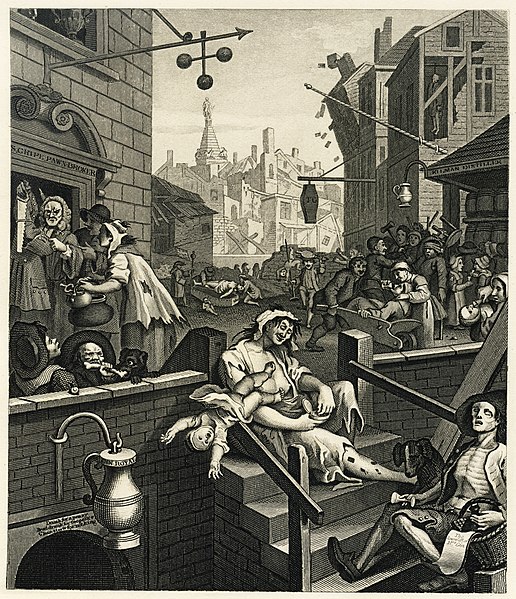
The image on the top-left is the 1751 print 'Gin Lane' by William Hogarth, one of a series of prints produced to popularise stricter alcohol legislation.

Monday, 25 February 2008

They Lied To Us.


The past week in the meatspace life of Pennyred has been spent guzzling pink drinks at goth parties, rolling in my own filth and trying to get a job. I feel a sinking sense of despair at the renewed realisation that we were all hopelessly lied to in our youth. Real life isn't the thick slice of fun pie we were led to believe. For example: kick and wail at the notion though I may, I am resoundingly a spoilt Blatcherite brat by inheritance: bright, white and middle-class, scholarship to a nice school, degree from an Eminent University, lots of drive and ambition, relatively supportive parents, neither stunningly unattractive nor a pneumatic blonde fem-bot, both of which happen to matter a lot if you're young, female and looking for work. In short, I've got everything going for me on paper, bar heteronormativity, mental equability and a Y chromosome, but we'll save that little rant for another day.
And yet, to my great surprise, I have as yet failed to be head-hunted for a top job in media, government or M16; I have as yet failed, in fact, to secure any employment whatsoever since being fired from the Shop Job of Doom. And somewhere deep in the saccharine-sticky recesses of my middle-class soul, something feels that this isn't quite fair. This isn't how it was supposed to go! They told us we would be okay if only we worked hard and tried to be pretty! They told us we'd be successful if we studied for the exams, wore the right shoes and had the right parents! They LIED to us!

This city is over-run with kids like me, thousands of us, stunned by the acrid complexity of the real world, weighed down by debt, overdrawn, underpaid, poorer than we've ever been, chasing the rag-ends of dreams we've been encouraged to entertain since birth. Smoking, drinking, guzzling vile chemicals and dicking around with one another's hearts, because it numbs the anxiety, gives us a break from the cruel meritocracy grinning back at us through the curtains of our shabby living-rooms. Begging anywhere for work experience, internships, trying to polish our shiny young faces and even shinier CVs until they glisten with desperation*, paying our way with insecure minimum-wage work that saps the soul and leaves us grubbing in our battered wallets for the coppers to make up tonight's beer.

This was supposed to be the future.

We are probably going to be fine. But it won't be soon, and it won't be in the way we were made to believe. We can't expect to win by playing along, but what else can we do? After all, they're the ones with the power. They've got the money and the guns and the government and God, they sign our paycheques, mark our exams and grade our various crawling efforts to please. What have we got to challenge that?

I'll tell you what we've got.

We have Art and Beauty and Love and Truth. We have a flourishing counterculture that's more alive than anything the mainstream has produced in the last twenty years. We have semiotic sorcerers and guerilla literary theorists. We have Chaos Majick. We have sexual deviancy. We have the talent and the information-delivery media to reprogramme the minds of Young Corporate Leaders and drive them, frothing, into the sea. We have memetic attacks and the vote. Most importantly, we have much better hair.


This was written by a good friend of mine over two years ago, when we were young, stupid and indulging in wildly intellectual drunken reprobation at said Eminent University. To it I shall now add:

Unlike you, we are truly hypertextual. We have the information and communications technology to entirely re-imagine the concept of socio-political power, and we are bright enough and brave enough to use it. We are multi-ethnic, multi-gendered, multi-talented and massively up for a fight, we are no longer frightened of your disapproval, and we have bombs.

Love and Squalour bombs.

Up yours, Mr Meritocracy. We're going to win this our own way.


NB: Pennyred is a CV-enhancing excercise written by a nice cardigan-wearing girl from Richmond who would vote Tory. If you have enjoyed the writing of Pennyred, why don't you mention this blog to your employer? Pennyred is available for children's parties, corporate events and layby buggerings, and is happy to receive payment via Visa, Switch, Sterling, Yen or Euros (no $US) although will accept services rendered, sexual favours or the blood of the innocent.

Tuesday, 19 February 2008

Hunter, Hellraisers and Viral Democracy...


Today is the third anniversary of the suicide of Hunter S Thompson. Rest in peace, you mad old bastard, and thanks for the dream. A brief digest of the press this week is enough to prove that this world was never meant for a rule stomping genius like you. ....

****

It's not often I'm driven to a book review by sheer annoyance. Oliver James' Affluenza, however - currently number three in the bestseller lists and rising - is such a staggering load of abysmal, dangerous rubbish that it was review or risk self-poisoning by paper sludge in an attempt to vent senseless rage at the book by chewing and eating it. Affluenza is a muddle of trite social 'observations' strung together by no more than a series of carefully chosen anecdotes, under-researched or unsupported at best, casually racist, misogynist, classist and breathtakingly anodine at worst.

To give James his due, he starts off with a fairly sound piece of reasoning - human beings in the west have come to see themselves as 'personality commodities', and behave accordingly, resulting in massive increases in depression, anxiety and emotional ill-health. This is all keyed in to what James, in a stunning feat of tautology, terms 'Selfish Capitalism'. From there, however, it's all downhill: the first chapter is used to introduce the weary underlying metaphor of the entire 546 page tome, namely that one can become 'infected' by Selfish Capitalism and by personal commodification, henceforth referred to, in almost every churning paragraph of the
book, as the 'Affluenza Virus', or simply 'The Virus'.

This, to me, smacks of an author who liked 'The Matrix' trilogy a little too much (even 'Revolutions'). James' reasoning, however, fails to reach even the limited levels of subtlety commanded by the Wachowski brothers, not to mention that the fight scenes aren't half so cool. The sizzling hero, moreover, leaves much to be desired: James himself is an obtrusive prescence, cropping up everywhere, 'like an itinerant Marie Curie...triumphantly clutching vaccines which immunise us against the Virus, phials of tactics for making the best of the very bad job the world has become'. Oh yes, Oliver, thrust those tactic-phials deep into our sick and trembling 21st-century souls: only you can save us.

Within the first few pages, James comes out with such gems as:

'Whilst poverty fosters survival materialism, it does not result in illness'. (Been to Africa at all, Oliver?)

'women are more materialistic in their preferences when choosing a partner'. (Not explained, not supported, just plonked there as the given background to a series of paragraphs on how the grabbiness of the girls on Sex and the City can be put down to physiology).

Comparing a New York Banker to Chet, the amiable Nigerian taxi driver who had driven James to the meeting -'his apartment was big enough to fit a whole family of Chets'. Yes, because all African descendants like to live in huge, tribe like families, and can be reduced to the same cheery, poverty-stricken archetype. Of course.

I'm really not making this stuff up. All of James 'evidence' is anecdotal. Some unsourced statistics are peppered around the place, but in vague and generalised terms, such as when he declares that, at one Oxford college, one in three female students claims to have been seriously eating disordered at one point in her life, and one in ten is currently suffering. The college, Mr James, was University College, Oxford, and I know exactly how easy that statistic is to find, because I myself used it in a last-minute addendum to an article for my student paper about 6 months before your book went to press. Must try harder.

Now let's talk more about what James thinks about women:

'Do not deceive yourself about the reasons you are returning to work. Do you really need the money? Can you not live in a cheaper house or cut down on your outgoings? The authenticity, vivacity and playfulness of small children is hugely rewarding, a much greater boon than any number of promotions or pay rises...'

'Women who divorce or separate are often more depressed after doing so, even if they were with a truly vile man...before you divorce the father of your child, see a therapist and check what you are bringing to the feast.'

'If you have a daughter who is already showing signs of being a high-flyer, discourage academic prize-hunting and engage with her authentic interests'

[Susan is a talented, high-flying and wealthy advertising executive, interviewed about her self-starting skills]. 'When I made the obvious point, that a relationship in which she might find herself depending on a man must have been rather daunting....' - yes, because all successful women will come to depend on one man eventually, if they want to be truly fulfilled, won't they? Ta for clearing that one up.


What sets the teeth on edge about Oliver James' absurd generalisations on the state of feminism today isn't his casual dismissal, nor the way in which, in a book whose premise is to stop people seeing themselves as commodities, he persists in treating women as base-line baking-tins whose primary purpose is to squeeze out babies. No, it's simply the way he spouts all this humourless, gender-reductionist rubbish so patronisingly and self-importantly, as if he were the first person ever to have thought of this, and wouldn't we all be so much happier if we just listened to him?

Homosexual men and women do not exist in James' fantasy world, and nor do bisexuals, poly- or trans-sexuals, or, indeed, anyone who doesn't see marriage as the ultimate goal in life -his 'four types of marriage', which takes up much of Affluenza's 'women and relationships' section, is good for a giggle. Just don't let it stick between your teeth. When not being casually misogynist in a roundabout advocation of a return to fifties' gender-stratification, James' solutions are primitivist, reductivist, and based purely on observations of one set of people: the white, monied middle-classes. How this book is meant to be the 'sizzling reality check' claimed by its promotional material remains arcane.

What's even worse is that Affluenza is remarkably easy to read, which means that this banal piece of social propaganda will be gobbled up by commuters and stressed middle-class homemakers across the country. Apparently, James is already planning a sequel. Yes, that sound of rumbling, squelching and distant blasphemy is Hunter Thompson turning in his grave.


*****

Elsewhere in the travesty that was once the British press, the Guardian, in a move that was either sheer PR genius, tit-itching stupidity or some sick hybrid of the two, saw fit to launch a blog by the clueless son of an in-house travel writer, detailing his plans for his gap-year trip to the colonies the young, dumb middle-class swilling fields of India and Thailand, for booze, birds and other horizon-expanding pursuits. 'Cliches', declares Max Gogarty, 'exist for a reason.' The comments make excellent reading, and, much to my gurning delight, the poor boy has already made it into the Wikipedia entry on nepotism. Great to see that press hypocrisy is alive and well upon this most auspicious of Wednesday afternoons, even though other Guardian employees have risibly tried to defend the kid by comparing his situation to the Cultural Revolution. I'd feel a little more sorry for darling Maxie if he had anything to say, or enough wit and self-effacing panache to say nothing with style. But this is bland, content-free garbage, and fair play to the CiF commentators who brought this shocking editorial decision to book. Max Gogarty has justifiably become an internet 'virus'.

Daddy has stepped in
now, of course, but too late to stop the wave of mostly reasoned vituperation from commentators within the Guardian network and beyond. Rafael Behr bewails, in response to poor Maxie's plight (according to his father, 'he has said that he doesn't like the media world now. He doesn't want to go into it any more.'):

'The web is no community. It is brilliant for some things. It does information, misinformation, entertainment and commerce. It does freedom. But one thing it doesn't do is democracy'

In fact, this is a perfect of example of hyper-democracy in its purest form: the power of the people in an age where the mainstream free press is anything but. Barely twenty-four hours after this 19 year old's self-satisfied Great Sneer diary is launched, hyperspace is ablaze with voices of denunciation, and the piece is pulled.

Forget 'affluenza', this is real modern Viral politics at work: the potential of the internet to spread information and and rouse response to hypocrisy, nepotism and patent class privilege. The press may not be free, but between us we've got the power to bring truth and reason to the offices and boardrooms of the rich and privileged. There's magic in that. Perhaps Saint Hunter would have been proud, after all.

Monday, 11 February 2008

Porn: what is it good for?


If you just threw up a little bit in your mouth, you're not the only one. Go and swill out, then keep reading. Images like the one on the left use the conceits of violent pornography - in this case, gang rape - to sell everything from clothes to cars to washing powder. Violent pornography has become part of our cultural language.
But is censorship the answer?A recent article of mine on The F Word in response to the new UK porn laws laid down by the Criminal Justice and Immigration Bill 2008 generated a surprising amount of controversy. In brief, the government wants to ban various forms of 'extreme' pornography, including bestiality, necrophilia and some 'snuff' porn. I argued that censorship is not the answer, nor will it do anything to reduce the harm violent and extreme pornography does to some individuals' sexual and personal development; I argued that censorship will drive the industry further underground, making it more racy and enticing and generating an unsafe working environment for those involved in producing 'extreme' pornography. I mentioned that there is little extant evidence to suggest that 'extreme' pornography leads directly to extreme sexual violence. I was declared naive and gullible by 'Radical' feminists and anti-porn sexists alike, claiming that pornography is harmful, hateful and extremely socially damaging. I must protest at this, and not merely because noone who has read the synopsis briefs for SlutBus 4 and A Filthy Little Cocksucking Whore Named Marilyn for research purposes will ever ever be quite so naive again. I never claimed that violent pornography was not damaging. Violent pornography is unquestionably, incontrovertibly damaging, and as a feminist against censorship I am achingly aware of that fact. I merely happen to believe that porn censorship is not the answer, and that the Bill currently on the Commons table will do fat, shiny nothing in a bag for women's liberation.

Do I believe that violent porn directly causes sexual violence? No. Do I believe that banning it and driving it underground will do any good to anyone? Absolutely not. Do I believe that physically and emotionally violent pornography is symptomatic of an endemic social paradigm wherein masculine power and cruelty is eroticised, and that this paradigm leads to sexual violence amongst many, many other atrocities? Hell yes. Yes, I do.

The question of whether pornography directly causes or does not cause sexual violence somewhat evades the real issue. The reason that pornography is such a sticky problem, the reason that many feminists hate and fear pornography, is the same reason that many in the pro-patriarchal sphere are willing to go to the wire to defend it: mainstream, heterosexual pornography as it is mass-produced by western society holds up an accurate mirror to the violently misogynist world in which we are living.

Let me repeat that for the confused or post-orgasmic: the fact of pornography itself, however ‘extreme’, is not socially harmful, but the messages inherent in most western pornography, never mind the ‘extreme’ end, re-enforce social paradigms of sexual inequality, male sexual subjectivity and violence against women. When I say that ‘the quality of most porn is dreadful’, this is what I’m talking about.


You are what you jerk off to.

In this pornographic world, inequality and injustice are eroticised. Power and dominance, for the most part of men over women, are eroticised. The exercise of that dominance in cruel, violent or humiliating ways is eroticised, and when something is eroticised in the mainstream to this extent, it becomes normalised.

What isn't extant in porn is almost as critical as what is - to whit, respect, tenderness, human emotion, sensitivity. I'm with Jensen in conceding that there are economic as well as ideological reasons for this, namely that most pornography is bought by men as aids to masturbation, and on-screen emotion tends, it is posited, to detract from the salient pleasures of self-stroking. Some form of psychological kick has to replace that tenderness or affection as a narrative hook - hence the introduction of cruelty and violence into the remit of Joe Average Mustachioed Porn Director. I’m not yet proposing radical tenderness as a social strategy, not least because it would put paid to my favourite hobby of sitting in smoking rooms, drinking vile coffee and hating things. But I'm behind the radfems in noting that its total erasure from pornography is worrying, to say the least: pornography leached of mature emotional responsiveness is often (indeed, usually) the first illicit means of educating young men about sex. For almost half the population, violent or objectifying pornography is now the cultural blueprint for sexual relations. What does that mean for gender politics, and what are our options other than to lash out at the offending material?

If patriarchal culture, where rape and gender-fascism are facts of life, is the disease, then the many forms of porn are the oozing, blood-crusted pustules that cluster in the tenderest crevices of the diseased body. Like children, we attack the sores with nails and teeth, ignoring the fact that the body itself is sick to death. By scratching at the pustules, we will only drive the rot deeper.


Corpse-fucking and the state...

So what is the government's response? How are our politicians working to root out the infection from our feverish, sickening gender paradigms? Let's let’s look again at that government bill. One of the first types of pornography that’s forbidden is ‘[images of any] act which involves or appears to involve sexual interference with a human corpse’ – that is, necrophilia. Now, correct me if I’m wrong, but necrophiliacs are a very small and specialised sect of the fetish community. There will never be enough necrophiliac porn, just as there will never be a large enough necrophiliac culture, to normalise corpse-fucking as a social paradigm. And frankly, if that’s your kink and you can excise it by watching badly made-up zombies shag each other on telly, then fair enough. So why is it that pornography that appears to show necrophilia – a very rare and totally illegal practice that doesn’t really have much of a social discourse – is NOT okay, whereas pornography that shows live women appearing to be raped, humiliated and beaten to within an inch or their lives is totally fine?

Let’s grit our teeth and face this one: it’s fine on television because it’s normalised in society. Maggoty, squelchy grave-diving turns the stomachs of our politicians, and yes, I’m a kink-friendly, accommodating anarcho-buddhist with not much sympathy for the meat of the body, but I can see why that might be. The bill covers necrophilia, bestiality, 'snuff' movies and severe injury to the sexual organs. Rape, all other sexual violence, extreme female submission, double- and triple-penetration, humiliation, sexual cruelty – all of this fails even to make it into the draft bill, because it’s been normalised in western society. Not only that, but in a neo-liberal capitalist system there could be no question of banning this type pornography, because such an action would by now mean outlawing nearly all heterosexual porn. And porn generates more revenue than the entire British film industry, minus many of the overheads. Not only is banning violent porn not the answer – it’s not even the question yet.

Censorship of 'extreme' pornography will not solve the problem of sexual violence and gender fascism eating away at the bones of progressive western culture. Instead, we need the courage to look into that mirror and respond appropriately to what we see there. Whether disgust, direct action or bland acceptance, our reaction to these images determines who we are, and who we will become as a society.