Monday, 31 August 2009

Reproductive freedom and racial paranoia: or, why Melanie McDonagh can fuck right off.

Shock, horror, disaster: the population is exploding! Yes, the recently-over-reported demographic expansion of 1%, incidentally mitigating the encroaching pensions crisis, has kicked off a chain of explosions - explosions of racial paranoia, class hatred and misogyny. The tabloids, broadsheets and a few bewilderingly respected racist lobbying groups have lost no time in hosting a drooling orgy of dated ideology, merely because a significant portion of the babies being born are, apparently, the wrong sort of babies – babies from ethnic minorities, babies with immigrant parents and lone parents, black babies, poor babies. And according to Amanda Platell of the Mail and Melanie McDonagh of The Telegraph, what this means is that middle class, “Anglo-Saxon” women now have a duty to have more babies in their twenties. I have a spare set of sewing scissors around if anyone cares to unpick the various strands of racism, misogyny and class prejudice going on in those assumptions - let’s just say that it’s all intersectionally fucked. This is a feminist blog, however, so we’ll zone in on the feminism.

I'm going to work on the assumption that by "Anglo-Saxon...women", McDonagh is not making a complex statement on the superior genetic heritage of two of the many waves of immigrants to the British Isles in the past few millennia, the Angles and Saxons as opposed to, say, the Jutes or the Romans or the Vikings or the French, and is instead equivocating over her own racism: what she means to say is that 'white women should be having more babies.' And despite my Mediterranean-Slavic heritage, I'm fairly sure I'm one of the nice young lilywhite gels McDonagh wants to see breeding like paranoid supremacist bunnies.

To which my response is: fuck. Right. Off. I’m not going to be told when and how and with whom I may breed, by anyone, thanks. My body is mine: it’s not a tool of your crumbling kyriarchy, it’s not a self-replicating node in your future white race, and it's not a mute block to shore up a class structure contorting in the face of global migration. Fuck off with your misogynist frothings: I’m not anyone’s baby-making machine. I don’t care when I ‘should’ get pregnant. I’ll carry a child when I want, or not at all.

Moreover, the question begs itself: what precisely has been done over the past, hm, twenty-three years of my life to make it easy or attractive for me to have a child now that I’m in my twenties? Has anyone made it easier for me to combine childcare with my career? Is there a decent nursery placement system, a guarantee that I won’t be fired from my job? Can I definitely work flexibly or part-time and still bring in the money I’d need to raise a child in relative comfort? No? Then, as I may have mentioned, you can fuck right off.

The age when women had babies on everyone’s terms but theirs is dying, and when it finally dies myself and many other willing ladies will gladly line up to piss streams of contraceptive-hormone –laced urine on its sorry grave. Yes, I’m sure it was simpler when patriarchal capitalist social engineering could be affected by refusing to acknowledge a few billion women’s personal agency and capacity to say no. I’m sure it’d solve a few problems in the short term if one half of society suddenly went back to being an unpaid sub-class of slave labourers, squeezing out and raising babies of the correct class, creed and colour, all for free, for the good of the fatherland. But it’s not going to happen, and you can either accept that and work with us or you can shut up and quit your whining. Either way, you'll find yourself making space sooner or later in your boardrooms and offices and benches of justice for the children of 'foreign-born' mothers and for those mothers themselves.

The sublime irony of all this is that if women’s concerns had been taken on board back when we first started pressing for reproductive freedom, if we hadn’t had to spend the past decade fighting campaigns to defend the few precious rights we have to control our own lives and bodies, if we had a system to facilitate free, safe, legal abortion as early as possible and as late as necessary, if we had the morning after pill free and on demand and available in our own homes, if we had a decent childcare system and real, comprehensive sex education in schools instead of the piss-poor, prudish information we dribble out to our children,leaving them to get their education from pornography and television, if we had any or all of that then the right wouldn’t be finding themselves blindsided by sudden demographic change. Because what happens when one is miserly about reproductive freedom is that only certain women are able to exercise it, and those women are almost inevitably the richer ones.

It’s a staggering insult that, more than forty years after abortion was legalised and equal pay acts came into force, the commentariat is blaming women for the fact that the lucky ones amongst us are choosing to exercise the privilege of having fewer children, a privilege that should be every woman’s right. It’s insulting to blame women for exercising the limited choices they have rather than accepting the real consequences of keeping those choices limited.

Personally, I’m more than happy for the generation that comes after me to be - gasp! – over a quarter of immigrant heritage. But just for kicks, let’s go with the notion that a ‘middle class baby boom’ is actually something desirable. If this government and the next wants a greater proportion of babies born to middle-class mothers, it can start by making part-time working a real, highly paid option for men and women everywhere. Give everyone, not just parents, the right to request flexible working and home working, and end the throwback 9-to-5 working culture that’s destroying our mental health as a nation, not to mention our childcare arrangements. End discrimination against mothers and potential mothers in the workplace, and make combining motherhood and paid work a viable choice. Introduce comprehensive, compulsory sex education at every level of schooling from year 5 up – and make sure our children know more about sex and contraception than we did before we started having it. And whilst you’re at it, put some money into sorting out the damn education system so that more of the babies born to immigrant and single mothers will have a chance not to fulfil the disgusting sense of class destiny inherent in this week’s right-wing reasoning.

Reproductive freedom isn’t a fad; women are not going to suddenly get bored of pushing for emancipation at home and in the workplace. If the freedoms we have fought for continue to be restricted and distributed unequally, always with the threat of being repealed any minute, then demographic change won’t be the only surprise the socially conservative, racist right finds itself having to come to terms with. Women’s bodies can no longer be manipulated in the cause of elitist social engineering, especially not the bodies of middle-class women, who enjoy more comprehensive reproductive freedom than their less wealthy sisters. Rather than attempting to pressure and cajole middle-class women into reproducing, the right would do better to encourage education, childcare and reproductive emancipation across the board– not to prevent working-class, immigrant babies being born, but because education and reproductive freedom are every woman’s right, whatever her income, background or country of origin.

Thursday, 27 August 2009

Watching the watchers: Climate Camp and the summer of rage

Shambling through the kitchen with my face in a massive plate of pasta last night, I heard the door crash open: my friend who shall henceforth be known as Activist Polly*, veteran of the summer of hate, had come back from Climate Camp.

'Oh my GOD, Laurie, it was awful,' she moaned. 'Climate Camp was full of hippies!'

The fact that Polly might have expected something different is key to the essential weirdness of Climate Camp. The idea is - well, it's not simple, but stay with me. It's a protest, you see, a four-day sit-in protest about...something. The environment. Capitalism, also. And associated...badnesses. And we swoop, you see, we all gather in various parts of the city and swoop, not walk, swoop, on text-command from our remote superiors towards a target which we don't know what it is yet but we'll definitely be told about on the day. Possibly we'll go to the Bank of England, and everyone will see, because it'll be in London. I'm certainly planning to take lots and lots of photographs. How about you?

Being a young cool lefty kind of person, I'm aware of many people who are at Climate Camp - and every single one of them has gone with the express or primary intention of taking photographs. Photographs of the protesters; photographs of the police, in particular, as public rage over not being allowed to turn the gaze of surveillance back on our beetle-backed overpigs is still simmering merrily away. Hundreds of amateur photographers - and that's not counting the thousands of press cameras, which reports from the frontline assure me practically outnumbered those who were officially there to protest. Every single one of them just waiting for something to kick off between the coppers and the crusties like it did at G20.

The question begs itself: if you have a protest where most people have gone along to take photographs of a protest happening, is that still a protest? If so, what about? In the case of Climate Camp, any original intentions seem to have been lost in a flurry of press taking pictures of the protesters taking pictures of the police taking pictures of us. Political voyeurism: marvellous, and utterly mad.

Climate Camp is, at root, a protest about having a protest. A glance at the extensive and exciting-sounding programme of workshops shows more sessions about - activism for students, community organising, the legacies of the Brixton riots, than sessions about the actual environment. M'ladies from Feminist Fightback, never previously the vegan police, have gone down to lead a workshop about the targeting of women in protest zones, tying it all together with Greenham Common. A glance at the shiny shiny website turns up 'Photos from the Camp', 'Media Circus Twitter Feed' and 'Our Open Letter to the Police' and precisely zero aims and objectives.

This is a virtual protest, conducted on Twitter and Flicker and in the newsfeeds of all the major paper sites, all waiting for something to happen, for the violence behind the screens to transfer to ephemeral meatspace reality. We've set the bar for the ultimate 21st-century direct action: a protest where nobody apart from press, photographers and twitterhounds turns up at all and they all have to watch each other and take pictures of each other in an infinitely recursive loop of pseudo-political voyeurism until we are all drained entirely or someone behind a camera screen somewhere stumbles across the face of truth.

This has been a hard, weird summer. People are in pain, and they are angry, young people in particular: but the response to that anger has been confused. A significant proportion of this summer's protestors have not been politically active before; hopelessness, worklessness or a dawning comprehension that they're all a bunch of bastards who want to screw us and then take pictures of it has driven a lot of young people into political activism, many of whom lacked an initial understanding of the issues involved. That's not necessarily a bad thing: but it changes the terms of this summer's political unrest to something more directionless, more systemic, more fundamentally frightening and exuberant.

All of those lost kids pulling on their flak-jackets and soft-shoeing it down to the police line, all of them have cameras in their pockets. Cameras are the contemporary semiotic equivalent of the concealed bottle, the brick in a sock, the pocketknife: they are understood as power in the hands of the people, gaze and evidence and connectivity and protection, keener than any blade.

Which is just as well, really, because if the majority of this summer's protestors hadn't though it was more effective to bring a camera to a demo than a big fuckoff stick, it might all have got a lot more bloody. There is anger, now, on the streets, in our living rooms, seething. The young are fed up and chancing for a fight. The Met police are on record saying they're 'up for it'; the people on the other side of the cordons want to kick something off; the press and hundreds of amateur photographers want to be there behind a screen taking notes when that thing, whatever it is, kicks off.

The irony is of course, that is IS kicking off - in Birmingham and Codnor and in a score of other places away from the glare of the cameras, neo-nazis are trading blows with anti-fascists, feminists are marching, socialists are organising. But outside London, the press aren't interested; instead, we're drawn to the pretend protest, the virtual protest. Instead, we're all standing on the protest line behind little flashing screens, watching them watching us watching them.


*Activist Polly wishes it to be clear that she does not agree with the content of this article and that any comments about fucking hippies were made strictly in jest.

Friday, 21 August 2009

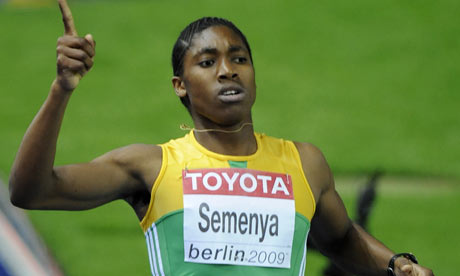
Being a Woman: Germaine Greer, Caster Semenya and gender paranoia

This is painful for me. I was scribbling notes in 'The Female Eunuch' and 'The Whole Woman' before I lost all my milkteeth; I worship her irreverent, punchy prose; but there's no escaping it. These days, Germaine Greer is a prejudiced, ignorant dickwad.

In her rather confused verdict on the Caster Semenya controversy, Greer comes up with the following gem today:

'Nowadays we are all likely to meet people who think they are women, have women's names, and feminine clothes and lots of eyeshadow, who seem to us to be some kind of ghastly parody, though it isn't polite to say so. We pretend that all the people passing for female really are. Other delusions may be challenged, but not a man's delusion that he is female.'

In dismissing all transpeople as 'ghastly parodies', Greer hardly does any better in the grand game of unthinking prejudice bingo than the disgusting commentators who have decided that just because Semenya, a phenomenally high-achieving athlete, is big, butch and brilliant at sports, she can't be a girl. Let's take a little look at what womanhood is, according to Greer and others.

Greer believes that my 'womanhood' is defined by my tits, my bleeding cunt and my XX chromosome. She also believes that 'woman' should be my primary identity: before I think of myself as a writer, a journalist, a sister, a daughter, a lover, a friend, a consumer of trashy vampire novels, I should consider myself "a woman, first". In other words: my cunt and tits are what make me, me. Well, gonads to that.

What defines this holy femininity, in the radical feminist assessment? Is it having breasts? Having a twat? Being curvy? Being fertile? Having an XX chromosome? Yes? Well, then, it clearly sucks to be one of the significant proportion of women who are none of these things, excluding the trans population for a moment: the women all over the world who lack breasts after mastectomy or a quirk of biology; women who are born without vaginas, or who are victims of FGM; women who are androgynously skinny, naturally or because of illness; women who are infertile or post-menopausal; or the 0.1% of women who are intersex. Who's to say that these people are not women too, if womanhood is the gender identity that they prefer? Greer shares something with Christian Fundamentalists here: none of them are interested in the actual social and biological science behind their unthinking assumptions.

In fact, 'womanhood' is not a holy, immutable quality. 'Womanhood' encompasses a complex spectrum of biological facts just as 'femininity' encompasses a huge range of social and cultural factors. 'Woman' is not a binary fact, set irretrievably and forever against 'Man'. The reason that radical feminists and social conservatives alike find transpeople so terribly threatening is that they know this better than anyone else.

Transpeople know that however much it happens to mean to you, femininity is, in fact, something that can be bought from a shop*. They know that identity is fluid and that womanhood itself is not a fixed biological quantity. They know that the state of being a woman or being a man is something imposed from without, something that can be altered, and they are living, breathing proof of that radical truth. And that's horribly threatening to recalcitrants everywhere.

Let's come back to Caster Semenya, whose physicality is rather more of an issue for her career and identity than it might be for the rest of us. I for one am disgusted by the popular reasoning that any physically high-acheiving woman who is not stereotypically 'feminine' is an aberration, and therefore must actually be a man. Caster Semenya is a woman; she has lived her whole life as a woman; her genetics have nothing to do with it. The insistence by the IAAF that she 'prove' she is a woman - as if there were any concrete way of doing such a thing - is sexist on every level.

For the sake of argument, though, let's suppose just for one minute that Semenya does turn out to be XXY or XXX-type intersex, or a person with Androgen Insensitivity syndrome. Suppose that this incredible athlete, who feels that she is a woman, who has spent her entire career competing against women and expresses her triumph as a triumph in the sphere of women's sports, a female and feminine physical feat, happens to be amongst the 0.1% of women without an XX genotype. Why on earth is that a problem? And why should that disqualify her from women's sports? What, are they going to create a special intersex olympics just for her and a handful of others? Or will she be ostracised from the world of sport altogether because her body does not support the binary ideology of the IAAF?

The sporting world is a cultural throwback, as paranoid over the maintenance of strict gender binaries as, well, as your average Greerite radical feminist. But if we truly want to progress as a species - if we want to celebrate sporting acheivement, if we want to strive collectively and individually to run faster and swim stronger and jump higher and think more clearly, our frantic cultural drive to uphold gender as a holy and immutable binary is the first thing we need to abandon.
****
*For more on this and the capitalist connotations of femininity, I heartily recommend the excellent essay Mama Cash: Buying and Selling Genders by Charles Anders, available in several essay collections, although unfortunately I can't find it online!

Saturday, 15 August 2009

What Women Want

The past week I've been absent, alternating work with frantic end-of-tenancy cleaning of a house in exactly the state you'd expect after eighteen months of sheltering six extremely depressed precariously employed young people and Neets let down by the government and the economy, surviving on a pittance, on which more later. I have bleach poisoning, and possibly also vial's disease. But right now I have half an hour free, waiting for my small sister to arrive so I can show her the bright lights of London; so I thought I'd point any of you who haven't seen in the direction of Filament magazine.

Filament is a fantastic project, set up by Suraya Sidhu Singh, a multi-talented friend of mine. It's a magazine designed to show erotic images of men that please women, as a counter to the market saturation of male-gaze-oriented images of women, with the assumption that women are actually allowed to have desire of their own, rather than just being the objects of it. So far, so uncontroversial, right? Wrong!

Filament has been in the press recently after Comment Is Free decided to run with the story about how their publishers refused to print tasteful images of an erect penis, deeming them 'offensive' in a culture awash with soft- to hardcore images of breasts and fannies selling everything from porn to purifying facial wash. The extreme controversy and popularity of the article may have something to do with the fact that it's all about knobs (knobs! In the shops!) and has an erection pun in its title. But the piece and the comments are both worth a read if you've ever been interested in the sexual double standard - the same sexual double standard that you, right now, have a chance to do a little something to lessen by supporting Filament. Get ready, here comes the whorebaggery:

To stay in print, Filament needs you to buy an issue, or even, which you can do here. It's full of terribly pretty boys as well as interesting thinkpieces by men and women at the cutting edge of contemporary magazine journalism. They're halfway to their target already- all they need is a little help from open-minded people [and girls with a spare fiver who like to get their rocks off looking at arty pictures of tasty, nubile manflesh].

In case you needed even more persuasion, there's also a regular 'Ask A Feminist' agony aunt column, written by moderately-known shoutyblogger Penny Red, which I hear tell is an absolutely fantastic read, and only a fool would think otherwise. Go and buy the magazine, take back the gaze, and keep knobs in shops.

Thursday, 13 August 2009

We love the NHS! Sort of.

This article has also been published at The Huffington Post, with thanks to my boyfriend, Andy, for letting me pillage his life story for cheap points. I love you, baby.

My partner suffers from a bone disorder which requires regular operations, paid for by the British NHS. His most recent procedure was performed without anaesthetic by a drunken surgeon wielding a rusty hacksaw. As I forced a mouldy rag between his teeth to stifle his screams, an official wearing Nazi insignia burst in and informed us that limbs were not considered an NHS spending priority, so dirty chisels were employed to remove both his legs and one of his arms for good measure. My partner is now a triple amputee, and I am forced to prostitute myself for heroin to numb the pain of living in an Orwellian super-state. God save the queen.

This decidedly made-up story is hardly more ridiculous than the lies that Republicans have been peddling about the NHS all week. To set a few spluttering records straight: patients over 59 are not denied heart surgery; Professor Sir Stephen Hawking has personally come forward to say that he would not be alive without the NHS; and Republican hysteria over ‘death panels’ reflects more accurately the situation in the United States than in Britain. On both sides of the Atlantic, lofty officials get to choose how best to allocate a finite amount of healthcare funding – the difference is that the NHS bases decisions on its analysis of how best to deliver equitable healthcare for all, rather than basing decisions on the interests of its shareholders.

Brits all over the world have been stepping forward to defend the NHS, with ‘welovethenhs’ becoming a trending topic on Twitter this week, surely the ultimate signifier of public passion. The British are proud of our healthcare system, and even members of the Conservative party have pledged to defend it, knowing that without promising to uphold socialised healthcare their chances of election success would vanish.

What Obama is proposing is not a simple transposition of the NHS, although it will make for a fairer system if it passes Congress. He is right not to base his plan on the British setup: the NHS has its flaws. It’s not a simple case of NHS good, medicare bad.The reality, as ever, is much more complex, and is being obscured by half-truths, frothing right-wing paranoia and outright lies.

My partner’s illness, however, is real – so let me tell you what really happens.

Whenever he needs an operation, my partner receives top-quality care from our local hospital – eventually. Because his debilitating, agonising condition is not life-threatening, he normally has to wait many months for the free operations, and the process of consultation and aftercare varies on a sliding scale from risible to non-existent.

On the other hand, his disability makes him unfit for most work, and were we US citizens my meagre half-salary would doubtless put us amongst the 43 million Americans with no healthcare cover at all. We can and do complain about the NHS – being British, it’s one of our favourite hobbies – but the specialist painkillers he needs to get through his worst days are free, and they will remain free for the rest of his life.

It isn’t easy for my partner, being 25 years old and facing a lifetime of pain and limited mobility. He worries about his future; I worry, among other things, that any children we decide to have will inherit his condition. But one thing we never have to worry about is being able to afford those vital operations, or the medication that keeps him stable.

Moreover, if I were to fall pregnant tomorrow, even on my low-income I would be treated to regular check-ups, help to quit smoking with free NHS classes, ante-and-post natal care, and food vouchers so that I could afford to drink milk, eat vegetables and take supplements to safeguard my health and the health of the fetus. By contrast, staggering inequalities in the US healthcare system mean that the United States has the highest infant mortality rate in the developed world.

I’m proud to live in a country with ‘socialised’ healthcare. For all its faults, its shoddy waiting lists and its dreadful dental care, the NHS system erases health inequalities and relieves millions of people, rich and poor, from the burden of constant anxiety about medical bills and sudden sickness. Even more importantly, it creates the progressive impression that the physical and mental health of the nation is the collective responsibility of all its citizens. In the process, without making a fuss about it, the British NHS truly upholds the principles of life, liberty and the pursuit of happiness for all. If that’s socialism, then sign me up.

Tuesday, 11 August 2009

Not feeding the trolls: comments policy

Okay, guys, listen up. The Penny Red trollbridge is getting crowded. Since I instituted the comments policy back in May, the situation has actually got worse, not better. Half of the comments on here now are either pointless personal attacks or ugly, childish misogynist or fascist rants. Some of the best commentators have been driven away, and I've lost count of the number of times I've had people come up to me and say 'I used to visit your blog, but then the comments got awful'.

...Bad trolls. No more snackies for you.

So as of this week, if nothing changes, I'm turning the moderated comments back on. This post isn't moderated, so feel free to chip in below if you have an opinion on whether or not this is the right thing to do.

I really didn't want to have to do this. It makes me sad, because I want to value everyone's contribution. It also makes me mightily pissed off because, in case you hadn't guessed from the number of recent cross-posts, I am up to my tiny eyeballs in work at the moment and the last thing I need is to have to go back to personally checking every comment before it goes live. So here, my friends, is one last chance.

If in the next few days the posts on this blog do not turn up any new misogynist, hateful, pointlessly invective, irrelevant, off-topic or gratuitously lewd comments that don't contribute to the debate, I'll consider keeping the unmoderated format open. Go on, guys. Prove me wrong.

ETA: moderated comments on!

Saturday, 8 August 2009

More shameless whorebaggery

My article on Harman, misandry and honest feminism is currently thread of the day on Comment Is Free, along with a tiny picture of me looking very sulky indeed. Come on in and join the fray, the stupid is out in predictable force!

Tuesday, 4 August 2009

Review: The Noughtie Girl's Guide to Feminism

I’m facing a feminist dilemma. A few weeks ago, I agreed to review a book for this site, a book written by a friend and ally of mine, a woman I deeply respect. The Noughtie Girl’s Guide to Feminism by Ellie Levenson is an attempt to merge the type of froth-feminism peddled by Cosmopolitan and Glamour into something more meaningful and coherent. It’s a flouncily inoffensive go-to guide for the type of modern woman who likes the idea of self-respect and empowerment but is frightened that feminist politics comes with a mandatory buzz-cut, all wrapped up in a kitsch pink cover with the ubiquitous pair of disembodied stillettoed legs that screams “whatever this is it’s disguised as chick-lit!” Unfortunately, the disguise works a little too well.

Which is where my dilemma begins. I agree that feminism needs to reach out to the mainstream, to women who wouldn’t normally think of themselves as feminists, but still enjoy the rights feminism has won for them. I applaud the fact that more feminist books are being written with today’s young women in mind. I’m definitely over the moon that one of my feminist mentors has finally managed to secure a publishing deal and expand the remit of websites like The F-Word which have kept the coals of feminist movement glowing in these dim post-backlash times. But I can’t get around it: The Noughtie Girls Guide to Feminism makes me angry. It makes me want to throw things at walls. It makes me want to actually set fire to my actual bra whilst I’m still wearing it and run flaming through the streets of Hackney yelling “How did we come to this?”

Petty arson aside, the real heartbreak of Noughtie Girls is that both the concept and execution are so very spot on. I adore the fluffy, frilly presentation, the demotic language, the stubborn refusal to get bogged down in high theory, which has its place, but not in an introductory book for sceptical feminists. I love the way the whole thing is structured in bitesize crossheads, making it easy to open at any page and find something interesting. I even like the silly little Cosmo-esque “what kind of feminist are you?” quiz at the front of the book, which shaves gleefully close to self-parody. It’s perfect Tube-reading. It’s fun. It’s accessible. It’s the sort of thing that I might give my little sister for Christmas, sandwiched between something smelly from The Body Shop. But here’s the rub: it apologises too damn much.

The book comes across as an apology for a brand of ‘man-bashing, bra-burning’ feminism that never really existed. It spends altogether too much time dismantling the straw woman of the feminist who would forbid pretty young ladies from waxing their legs and wearing pink, and altogether too little time explaining why it is that that sort of feminist only exists in the nightmare fantasy Britain conjured up by editors at the Daily Mail. It spends so much time debunking the myth, telling its readers that it’s okay to be a ‘Noughtie Girl’ who likes high heels and pink drinks, that it ends up reinforcing the idea that ‘traditional’ feminism is something to fight against.

Sunday, 2 August 2009

Harman's foot-in-mouth feminism

Harriet Harman is right to suggest that having the top jobs in the Labour party filled exclusively by men is a terrible and outdated idea, as it would be for any political party. But her reasoning is flawed and ridiculous.

She explains her objection to "a men only team of leadership" by suggesting that "men cannot be left to run things on their own". Which is, of course, entirely untrue, not to mention lazily misandrist. Men can be left to run things on their own - indeed, they managed to run central government all by themselves for a number of centuries without setting the Commons on fire or leaving the Civil Service strewn with empty kegs, takeaway pizza-boxes and porn. What Harman totally fails to do is to make a case for why we should not be satisfied with having men in sole charge of government, even if they're competent.

We want an equal government because only an equal government can truly comprehend the interests of the people it serves. Of course, the past thirty years is littered with examples of brave male politicians who have worked tirelessly to advance women's rights - John McDonnell and Dr Evan Harris - and female politicians like Thatcher, Dorries and Widdecombe who have done anything but. But even male MPs working for women's rights have always done so in a context of solidarity with female ministers and women of power, advancing the female agenda as only they know how - consider, for example, Dr Harris' partnership with Dr Wendy Savage in countering last year's HFE bill to clamp down on abortion rights.

Her idiotic comments will, of course, be taken gleefully out of context by rightist pundits over the next few days, and there have already been charges that Harman is anti-meritocratic, with Prescott himself weighing in to say ”why take away from the party the right to choose its leaders on the basis of ability? You can’t dictate equality.”

Well, of course you can’t, John. Since Harriet seems pathologically unable to properly explain herself right now, let me: if we were a truly meritocratic society, this wouldn’t be a problem at all. If we had a truly meritocratic system that picked its leaders on the basis of ability and competence, one of the two top jobs would invariably go to a woman – if not both. To claim otherwise is to admit to a belief that women are somehow innately inferior.

Later in the same interview Harman goes on to suggest, more sensibly, that "in a country where women regard themselves as equal, they are not prepared to see men running the show themselves." As Yvonne Roberts put it today:

"The idea that the individuals running an organisation ought to reflect the market that the organisation is trying to serve is increasingly common practice (ie it generates profits) in the commercial world – so why is it deemed such a revolutionary concept in politics?"

Why indeed? There are plenty of reasons to wish for a balanced government; productivity and efficiency is certainly one, which is the point that I suspect Harman was blunderingly trying to make in the first place. Genuine democracy - a government of the people, for the people, 51% of whom are women - is another. But we need to start being brave enough to make those arguments upfront, without apologising. If we don't, we'll risk doing what Harman has just done, and making a very reasonable suggestion sound callously anti-meritocratic and misandrist.

Monday, 27 July 2009

Media lies and the 'Me First' generation

Ooh, look. Here’s some probably-quite-new-fairly-meaningless statistics about youth, gender and mental health from which people with no knowledge of psychiatry and little conception of the complexities of mental health difficulties and young people’s lives can extrapolate almost anything they fancy. What fun. Let’s see how insensitively we can completely miss the point, shall we? That’s probably what I’d be thinking to myself were I an overpaid broadsheet grunt; as it is, I’m an angry blogger, and a youngish woman with mental health difficulties to boot, so all I can do is stand at the sidelines with my modicum of inside knowledge and carp at the immense cocking stupidity that’s been hashed out in the press over the past few days.

Let’s start with the earth-shivering ‘revelation’ that gets wheeled out every year or so: that feminism has failed to make women happier. It’s been standard Mail and Telegraph fodder for ages, but now the Graun have stepped in too, spinning Madeleine Bunting’s piece on how ‘consumerism’ is ‘damaging’ women for all it’s worth. Bunting’s moderate article is drawn from the more thumpingly derivative conclusions of smug pop-psychologist Oliver James, whose job is to travel around the world being surprised that people as rich as he is aren’t happy. He, too, is deeply concerned for the moral and spiritual health of young women, given that recent studies have shown that – shocker – some 15-year-old-girls aren’t very happy and also like a drink. He deplores the fact that “Victoria Beckham [is]consistently the girl they most want to be during this era”. Yes, that’s right. Because as far as Mr James is concerned, Victoria Beckham – 35 years old, world-famous model, fashion designer, businesswoman, former singer and mother to three children – is still nothing more than a “girl”.

James, like Bunting, is simply appalled that women and girls aren’t happy. After all, what more could we want? Haven’t we got the vote now, and the right to work almost as good jobs for almost as much money as men whilst still carrying out 80% of unpaid cleaning and caring duties? Haven’t we got the right to behave however the hell we like as long as we’re not old, or ugly, or overweight, or lesbians, or left wing, or non-white, or happily unmarried, or disabled, or poor? If we’re not all gurning beatifically now, surely that means that we were wrong all along? Shouldn’t we get back to the kitchen and find husbands to bear cookies and bake children for, if we’ll be happier that way?

If you hadn’t guessed, I find all this gawping media speculation about women’s mental health disgusting, if far from surprising: down the centuries, casting aspersions on our mental health has been the number one way to keep women in check and limit our choices, from lobotomies for ‘nymphomania’ in the 19th century, to forced hysterectomies for hospital inpatients in the 1970s, to today’s handwringing over the mental health of women who choose to have abortions, as if women weren’t mature enough to take that risk.

Our choices are pathologised and moralised and muddled together with the very sensitive, completely separate subject of mental health difficulty in ways that are achingly archaic and damaging. Not to mention demeaning, because as well as leaping to the assumption that ‘Women’s Liberation’ has actually achieved its aims, the attitude presumes that what women want – politically and personally – is to be ‘happy’. Who said we want to be happy? I thought we wanted to be free, to be fulfilled, to have the power to make our own choices and to lead our own lives, to be happy or miserable on our own terms. The suffragettes didn't fling themselves under the hooves of royal horses for 'happiness'. They had much more important things to fight for.

Ah well. At least the same sort of crass, derivative statistic-bending media hypocrisy isn't being applied to the mental health of young men as well this week. O hai, Anne Perkins.

New statistics from Childline
show that the proportion of boys calling the helpline to seek support for abuse, bullying and other distressing situations has doubled, from one in five to one in three. Rather than something to be applauded - suggesting that the millions of hours poured in by teachers, care workers and child psychologists trying to make boys more comfortable with seeking help have not been wasted - Anne Perkins suggests that this is in fact a sign of the moral weakness of our generation, what she calls "the 'because I'm worth it' generation'" in her rather unfortunately titled article When self-love is out of control.

Perkins' analysis of what makes boys unhappy is no less sexist, patronising and hateful than James' summation of the "toxins" ruining the lives of the young girls whose periods, let's not forget, are according to Mr James dependent on how attentive their fathers are:

There is a long list of candidates: laddette culture, Wags as models…and a massive sense of relative deprivation – always feeling you deserve better than what you have got, be that your boyfriend, MP3 player or your body. This was the It Could Be You era, one stoked by the advent of reality television in which girls such as Jade Goody, who would never have had a chance in previous times, became rich and famous just for appearing on Big Brother.

It was James, Perkins and their ilk in the first place, gangs of privileged media pundits from older generations, who decided that we were the generation that ‘had it all’, rather than, say, the generation who were trying their damn hardest to remain human despite being saddled with the highest expectations and least support structures of any group of young people in living memory. Not that that’s news, of course. Every generation tries to embody in its young its worst fears for itself, and our narcissistic, materialistic, addicted, self-centred, phenomenally up-fucked parents’ generation pointing the finger at us and telling us we’re moral degenerates is hardly news.

In fact, we are one of the less socially mobile generations of the past century; the real ‘It Could Be You’ generation, the generation with the most genuine opportunities for kids from lower income families, is the generation now making these ridiculous pronouncements: Oliver James and Anne Perkins' generation. To recap:

1.We didn't signed up to the women's movement to get happy; we'd rather be miserable on our own terms than Oliver James' fantasy grinning bovine housewives

2.The mental health of women and girls cannot be morally measured, and to suggest otherwise is highly offensive

3.The mental health of men and boys has no cultural value: it is not a sign of weakness or even of increasing distress that more young men are seeking help. In fact, the Childline statistics are to be welcomed

4. Mental health is not a gender issue: your mental health is not related to, or a predicter of, how good a little boy or girl you are. External arbiters of gender are, in fact, something that implicates your mental health rather than the other way around. Mental health difficulty has no moral value, and it cannot be placed on a map of social or gender deviance: it's simply a problem that a lot of young people, as well as a lot of not-young people, are trying to deal with from day to day.

5. Columnists: take your jealous mitts out of your cloth ears and try, please, to understand that the generation you so readily dismiss as narcissistic and frivolous has problems of its own that you can't even begin to comprehend, mainly because so far you haven't bothered, unless you're Nick Cohen.

Here ends the lesson

Wednesday, 22 July 2009

Blog Awards callout!

Shameless whorebag that I am, please do vote for Penny Red in the Total Politics Blog Awards if you've enjoyed reading it this year. Voting closes soon, so get yours in quick! It takes 2 minutes, you just have to fire them off a quick email.

If you've no other reason, vote for me because it's being hosted by Ian Dale, which, obviously, is gonna skew the results in favour of the right wing of the blogosphere, and balance is always good. Thanks guys. :)

Tuesday, 21 July 2009

Turn Left

There are only so many ways round you can ask 'what does it mean to be of the Left in Britain today?' before you start to sound like Yoda in the small hours of a party conference booze-up. Nonetheless, yesterday's launch of Demos' new Open Left project, spearheaded by James Purnell, threw up some very interesting points.

Purnell believes that left ideology necessitates 'choice in public services', which is a tad rich coming from the man who single-handedly purged the welfare state of its last remaining shreds of compassion earlier this year with his intricate schemes for lie detector tests, workfare-style sickpay deals and a punitive scheme for addicts and alcoholics. Will Hutton, fashionably late as always, talked a great deal about the language of fairness and 'just deserts'. The tone of the debate was consistently philosophical, which is absolutely fine when debate is also inclusive - but the elephant in the room was its narrow field of vision.

Purnell opened his talk by declaring that he had been refreshed, since leaving the cabinet, by the expansive vision and energy in the wide, wide political world of....thinktanks! I listened for the sniggers, but there weren't any. And looking around I saw why: in a roomful of 100 people meant to be talking about the future of the left, there were precisely no activists and nobody who looked like they'd ever spent time on state benefits. There were, however, plenty of Guardian journalists, a lot of folks from Demos and the Fabian Society and five - five! - people I personally knew from Oxford university. So where were the have-nots in the debate? Surely it was their conversation to have as much as anyone else?

I stood up to explain that I was living in a household of young people with the bad luck to be unemployed and suffering from chronic health problems, and that whilst the panel was equivocating over the real meaning of fairness most of us were lucky if we could afford one meal a day. I asked the room why we were not talking with and about the people suffering most in society today. I asked the room how many people there present had been unemployed for long periods, or had ever worked for the minimum wage, or had not been to a top university. By this point I was so angry that I properly started shaking. People came up to me afterwards to congratulate me rather patronisingly on my 'passion'. Why? Had they spent so long in think-tank land that they'd forgotten what an actual angry person looks like?

This, surely, is at the heart of the dilemma. Labour was established in 1900 as a party to represent the interests of the working class, but the urban and industrial working class as it was between 1790 and 1980 no longer exists. The large swathe of people working low-paid jobs in industry who gave the Labour party its name and its purpose no longer exist as a block with a unified purpose of reasserting control of the means and rewards of production. But there are still many millions of people in Britain who are poor, disadvantaged and subject to what Purnell called "arbitrary authority". If Labour isn't the party for those people, then what on earth is it?

John Cruddas pointed out that the Labour Party "has lost because we've embraced a neoliberalism which is brutal and individualist". The notion of collective good has been lost. Collective good is at the heart of what it means to be of the Left, and central to its instigation is, in Cruddas' words, "a notion of socialism, which is important to retain, whereby we preserve and nurture forms of interdependence and solidarity." In layman's terms: being of the Left is more even than the utopianism, the statism and the egalitarianism that Purnell lays out in his LabourList article today. Being of the left is about materially supporting, practically helping and politically including those less advantaged than ourselves, because we share a common humanity.

The labouring classes of today don't work in mines anymore. They work in callcentres, care homes, shops and hospitals; they are women as well as men, black and asian as well as white; they are single parents, the mentally ill, the sick and the unemployed, scrambling for a living in hard times; and they need a party that represents their interests just as badly as the factory workers and miners of the 1900s did. If it wants to survive at all, Labour needs to step outside the think tank bubble and ask not how the disadvantaged fit its agenda, but how it can best serve them.

Because if someone doesn't start coming up with answers soon, as Cruddas, Will Hutton and neophyte Lewis Imu pointed out, then extremist groups like the BNP will step in to fill that gap. In the last elections 900,000 people voted for the BNP, most of them from poor and disadvantaged communities, because no other party in Britain today is even bothering to consider what people on low incomes or no incomes, people living in the teeth of the downturn, really care about. Unless Labour can relearn that language, then the party is finished. And if the Left doesn't rediscover its social conscience double sharpish, we may as well all go home.

***

GEEK POINTS: The first person who can tell me why the picture above has been chosen to illustrate this post wins a hundred shiny geek points and a fabulous prize that I will invent later.

Friday, 17 July 2009

Alternative culture = fail

So back in 2007, when I started writing this blog, I worked for the flagship store of Cyberdog Industries. You know, the company that makes a lot of money selling overpriced poorly-made clothes to ravers and cyberkids and goths and metallers and the occasional indie Camden scenester who wandered in by mistake. My job was to stand around looking tiny and curvy and having a pink mohican and not complaining when tourists tried to feel me up at the information stand. I still like some of their clothes, though, only place you can get really reliable neon.

Well, anyway, Cyberdog has just launched a new t-shirt, which will no doubt shortly be glowing in every alternative club in London and Europe. It's called Tit Tetris.

No really, TIT TETRIS. The shirt, for those of you too lazy to click the link, features helpless women being flung to their deaths into a massive pile of female bodies. HOW VERY EDGY.

Ugh.

Wednesday, 15 July 2009

Torygeddon 1: Every Family Matters?

The Family – what does it mean, this ephemeral concept that makes Tory policymakers so very moist and excited? It doesn’t mean any old bunch of people bound together by blood and love. Ian Duncan Smith’s vision of The Family as propounded in his new policy paper, Every Family Matters, is the relatively recent kitsched-out 1950s incarnation of the nuclear heterosexual brood: you know, one man and one woman bound in holy wedlock, living together with their genetic offspring, him in the office, her in the kitchen. Well, that rules out my family for a start, and probably yours too. And yet Tory wallahs – not even in power yet but already slavering to sink their teeth into Labour’s social reforms – get all gooey over The Family. All you need to do is have a shyster mention 'ordinary families', as distinguished from the rest of us scum, and Tory spinsters start wetting their little knickers.
Every Family Matters wants to actively force men and women, who have been drifting gratefully away from the ball-and-chain-and-live-with-it moral mentality for generations, back into the heteronormative marriage model. If Tory plans are initiated, they will institute a compulsory ‘cooling off’ period of three months before divorce proceedings, offer tax breaks and benefits bribes for married couples, and demolish Labour plans to offer the same recognition to unmarried couples and civil partners, as well as boring us all with a whole pile of ‘Pro-Family’ rhetoric.
I am going to remain calm about this. I’m not going to point a shaking finger at the fact that the Conservatives are coming out with more and more evilly recalcitrant, misery-inducing plans by the minute. I’m not going to squeal and whine over the coming Torygeddon. I’m not even going to point out just how much Every Family Matters is completely at odds with their plans to opt out of the European Social Charter and attack abortion rights. Instead, let’s pretend that this dribbling piece of under-researched excuse for loo roll is actually a balanced and sane piece of policy, and analyse it on its own merits.
Right. The main premise of Every Family Matters is the notion that, since kids whose parents are married do better, more marriage will fix ‘Broken Britain’. Which is balderdash. Married parents do not create happy kids. Stable, affluent families create happy kids, and stable, affluent couples are statistically more likely to get and stay married. Johann Hari explains the statistics so I don’t have to, but the short version is: marriage is a symptom, rather than a cause of social stability. Simply putting incentives in place to bribe quite unhappy people into staying together ‘for the sake of their children’ isn’t going to magically create social stability. That kind of logic is cargo-cultism, and it’s lazy, and it’s stupid, and it won’t work because it’s stupid.
In fact, most research points to the fact that whilst children whose parents are married do, on the whole, perform better than their peers due to aggregate economic and social factors, children whose parents are married but unhappy do worst of all. A recent study of 341 children whose parents had divorced showed that, contrary to expectations, fully 80% said they were as happy or happier now than they had been when their parents were married, and only 25% wanted their parents to get back together. Clearly, pressuring folks back into a model of mandatory heteronormative marriage won’t make kids fitter, happier and more productive. So what’s the Tory agenda?
Well, if they want to create straw men to shift our focus away from social redistribution, they have to start somewhere. The document states: “Poverty places enormous strain on relationships, as does poor housing and lack of meaningful employment.” So the Tory strategy would be to improve housing and increase the minimum wage and thus strengthen relationships, right? Right? Wrong. “Supporting adult relationships must be a key concern of family policy rather than a peripheral interest.” So rather than get to the route of the problem and pursue social justice, they’re going to make laws to sellotape unhappy couples together and ‘readjust people’s expectations’. Brilliant.
Marriage also saves the state money, which is more important than national happiness. Encouraging couples to stay together means that we need to build fewer houses; Duncan Smith practically came out and said it when he told the BBC that ‘the idea of compromise from day one, two living as cheaply as one, seems to have disappeared.’
But the basic agenda is far less subtle. Cameron and his cronies simply do not LIKE women who live independent lives, or single parents, or gay people, or people with alternative notions of what a free and happy family constitutes. Promoting heterosexual marriage above everything else explicitly others those people, singling us out as socially destructive. In Torygeddon, we're simply freaks. And I'm sorry, but I don’t want to live in Mr Cameron’s world, particularly not when it’s raddled with hypocrisy.
Which brings us right back to this week’s ‘revelation’ about Tory plans to reduce the time limit on legal abortion without any commensurate easing of the sanctions on early-term abortion. This is a move that will not only significantly undermine women's vital reproductive freedoms: it will bring unwanted children into the world. It will leave us with more dysfunctional families, and put a great deal more children in the care system – exactly what Every Family Matters claims to stand against. David Cameron’s party has no real agenda for bringing about social change, it doesn’t really care about children, and its happy-clappy cuddly-wuddly mummies-and-daddies lets-fix-broken-Britain rhetoric has all the tenacity of soggy toilet paper. We need to get real about the basic hypocrisy of Tory family fetishism.

Monday, 13 July 2009

Irony

Right now, I'm getting ready to go on SkyNews and talk about burlesque, and whether or not it's empowering. Programme should be going out later in the week. And I'm planning to say something along the lines of of course it is. It's empowering to feel that you can control men, however briefly, with your sexuality. I'm not denying that there's power there, or that it feels good - actually, it feels very good indeed. But the question is, should we be interested in that sort of power? It's a limited and dubious form of empowerment, and not one that's particularly revolutionary.

So I find it mildly amusing that for the last half hour I've been running around the house trying to find something to wear that's modest but not TOO modest, frantically putting on make-up and doing my hair. Because I can't control sending a message with my sexuality if I appear on telly. All I can control is what sort of message I send.

It's kinda like rain on your wedding day, innit?

Sunday, 12 July 2009

Push the button, save the world: Torchwood and the British state

In response to a few requests, I'm continuing the review theme here. Partly because there's a lot of stressful stuff going on down in the trenches and I've been ingesting a metric buggerload of fantasy/sci fi/drama to get through it, and partly because, well. I've just this second finished watching Torchwood: Children of Earth, and it had me squeeing, and then shouting at the telly, and now it's got me thinking.

This is when Torchwood finally grew up, and I've come away with about ten times more respect for Russel T Davies than I had before. He's kept the cheek-wobbling ham acting, but ensured that the sex is far less important than the politics in the series, which is how it always should have been. The gay agenda is still there, of course, but there's simply too much going on for it to get much attention - which, in an ideal world, is how everyone should respond to the sexuality of strangers. And yes, they killed one half of the main gay couple, but in an incredibly bloody moving way that validated and contextualised homosexuality within the plot, a way that was definitively non-gratuitous. It was a GOOD death, it was shiny-dead-lover narrative logic turned effortlessly queer, and that's not something I've seen on TV before, and TV is what changes the way people think. That's why I love this show. It's shiny, it's clunky and it's all about ideas.


Bastards in suits sell us out: The Panto

This series didn't even try to make anything look particularly convincing, and instead pulled out all the old lo-budget sci-fi tropes, with the horrible robotic screaming children, wiggly green oscilloscopes down in the basement of Thames House, anti-poison boiler suits, and aliens so scary that no existing TV wizardry could possibly do them justice who spent the whole show growling in a tank of fog. And like all the best sci-fi, it was political satire thinly disguised as whimsy.

Turns out that we didn't need to see the monster in the tank at all, because the real monsters were the ones who were on screen most of the time: the ones behind the desks in Thames House. It all started to look suspicious when, soon after the horrible standing-still-kids started screaming 'We Are Coming', John Frobisher - Home Office Permanent Secretary, played brilliantly by Peter Capaldi - and various frazzled people in ill-fitting suits started blundering about trying to cover up something awful we'd done in 1965, which three episodes later is revealed to have been giving some aliens twelve parentless Scottish kids to torture until they released gummy chemicals that the aliens just loved to get high off. Dodgier still, the whole world was now looking at us, with every child in the world pointing at London and speaking flawless BBC English. When the same aliens, calling themselves The 456, finally did show up on our doorstep, it wasn't long before the PM and various ministers were around a table with an assortment of serious-looking world leaders being given a talking-to by the United States, looking like a 10-year-old caught shoplifting. Which was so painfully spot-on that it hurt a little bit to watch.

The first question on everyone's lips in the show was the most important, the one that the fine tradition of British sci-fi always forgets to ask: why us? Why do all the aliens and apocalypses happen to tiny, moist little Britain? Why were the kids even speaking English when, as Torchwood was at pains to point out, English is not even the world's most common first language (that would be Mandarin). The 456's response made me cackle: we came here because you have no significance. You are middle men.

Because that's what we are, isn't it. A nation of middle men. Of go-betweens and diplomats and middle managers, frantic to cover up anything that might put a stain on our reputation: just look at the next Prime Minister. Look at the government response to the policing of the G20 protests, where we were so very ashamed of how our rowdy populace would seem to world leaders that we were prepared to send the troops in on innocent bystanders. RTD's biting backhander worked because it was true. Of course, the real reason the 456 chose to crash on British soil was darker still: we'd given them kids in the past. They knew that we'd do it again. They knew that when threatened with any sort of inconvenience, the British government will take the coward's road. Even if it causes bloodshed and suffering, we'll play the big kids' game, hoping they won't hurt us: whether that's the USA or some bloody monster from the sky making vague threats to wipe out humanity. In Torchwood: Children of Earth, the 456 don't even bother to explain how they're going to kill us all: the merest threat of danger is all that's needed for the cabinet to give the order to start loading kids onto vans, and then, as it turns out, blame it all on the USA ,who were technically in charge at the time.

Of course, they had to to work out which kids to sacrifice. And my mouth fell open as the ministers round the table calmly ensured that their own children wouldn't be at risk. They start out by siphoning off the kids noone will miss - the failed asylum seekers - before agreeing to send 'the lowest-achieving ten percent' off to the slaughter. How were they going to determine which kids were the lowest-achieving? Simple: the school league tables.

Which is also exactly what would have been done today, for a definition of 'today' involving slime-spewing aliens. Torchwood made no attempt to disguise the government's cold class logic, with a government agent telling middle-class Alice Carter and her son: 'don't worry. The nice kids are safe. They're getting rid of the ten percent they don't want - the kids on street corners'. Meanwhile, the chavs on the Cardiff estate were the only people showing the humanity to fight back and protect their own kids as the soldiers dragged them screaming out of their houses.


Can't stop the signal

New Who is all about ideas, and one of RTD's most enduring obsessions has been with citizen journalism, with ordinary people taking control and 'turning the signal back on them'. In fact, that's precisely how RTD's protagonists defeat the bad guys in three out of four Dr Who finales to date, as well as countless other episodes. And yes, it's cheesy and it's obvious, but I think it's wonderful, wonderful, wonderful. And in this series the concept really came into its own, with heroic amateur reporters saving the day from the sidelines, and the Torchwood team holding the entire government hostage by threatening to release details of the dodgy dealings to the public. We'll release the tapes to the public is, in fact, the number-one absolute and final worst thing you can say to a politician, in Torchwood and in real life - has been since Watergate. The only thing we can do, whether we want to defeat aliens or our more earthly overlords, is to take control of the signal - and the way that simple agenda is handled in the miniseries is elegant and moving.

Because a British state ready to abandon its own people to pain, loss and hardship is not science fiction. It's happening right now, today. In the 20th century alone, the government sacrificed not 335,000 but millions and millions of its own citizens, mostly boys, some barely more than children, when faced with an enemy armed only with machine guns and lots of mud. Right now, our government is offering subsidies to wealthy bankers whilst kicking a significant proportion of the poorest and neediest in the nethers. Right now, our government is placing us all in terrible danger by maintaining an arsenal of country-killing weaponry simply in order to make themselves feel better about our dwindling importance on the world stage. Right now, saving face and staying powerful is more important than saving the world, and there isn't even a magic button we can push to make it stop.

In You Can Panic Now's far more erudite post, the writer concludes that the bleakness of Torchwood: Children of Earth prevents it from being truly excellent television - we're deprived of that glimpse of human heroism, that glimmer of hope at the end of a harrowing show:

The everyday heroism of human life is what is truly missing from this series, and it is deliberately excluded in favour of a political message: our leaders care only for politics, and in their pursuit of political power lose touch with real life, and we the people are too apathetic and powerless to stop them. Ultimately, the storyteller is responsible for the message that his story sends. And I think that Children of Earth failed, on Day Five, to deliver a message that was useful, morally coherent and worthy. Shocking and frightening us with the potential of our own brutality was step one, but it was not followed by a step two.

I'm inclined to agree, which is why I'd make a terrible TV pundit: I like unremitting bleakness. I find it energising not to be offered easy solutions. RTD has always been a nihilist, an atheist with an eye for showing us our own most terrible potential in disarmingly silly ways. The real genius of Torchwood: Children of Earth, as well as those shit-scary screaming kids, was its effortless grasp of what is truly to be feared in this world. The series didn't need super-CGI, brilliant acting or massive fight sequences. It didn't even need to take the monster out of the fog: the actual aliens were barely on screen at all. Turns out that the monster was on the other side of the glass the whole time, in Westminster, ready to sell us all out for the promise of a quiet life. We were looking at the monster all along: we're still looking at the monster, and ultimately we are offered no easy redemption. That right there is the sort of sci-fi that scares the bejeezus out of me. Bloody brilliant stuff.

Tuesday, 7 July 2009

Harry Potter and the Fascist Ubermensch

This post was co-written with Withiel Black.

Harry Potter frightens me. In case you’ve been in your box for the past week, film number six is about to come out, and all Azkaban is breaking loose amongst children and adults desperate for another fix of the boy wizard’s fantastic escapades and Alan Rickman’s sexy voice. Now, I love Harry Potter, I do. I stayed up all night reading it on my eleventh birthday, and cried at the end because according to the rules of the book I was destined to be a Muggle forever, apart from a brief period in year 7 when some fundamentalist kids tried to burn me as a witch. But re-immersing myself in the franchise as an adult and a political animal, these phenomenally popular books throw up some serious issues. Just what kind of story is it that 21st century kids are getting hooked on?

JK Rowling is in the world-building business, constructing an extremely financially successful arena of the fantastic with deep roots in a nostalgised and mostly imaginary Great British Past of lofty private boarding schools and crumpets for tea. However, her body of work ignores the essentially murderous and imperialistic connotations of the particular era that it evokes and valorises. The entire premise of the franchise fetishises primogeniture, heredity and aristocracy: the Wizarding world is a glittering ubermensch, and those lucky enough to be born into it are destined for a life more resplendent and exciting than anything the rest of us Muggles (non-magical humans) can hope for. Even the talent of Muggle-born wizarding citizens like Hermione Granger is phrased as immutable and innate, rather than meritocratic: Hermione’s parents are Muggles, but she is and has always been a Witch. We are told, time and time again, that apart from his jolly old sporting prowess there is nothing that remarkable about Harry apart from the circumstances of his birth and of his parents’ death; he is born and fated to be The Chosen One, The Boy Who Lived, acting out sequential showdowns with His Scariness just in time for the summer holidays. The Potter fantasy of the British class system is fairly clear-cut, and relatively harmless, although anyone who has attended a boarding school will be quick to point out that it ain’t Hogwarts, baby. Far more damaging is the notion that to have a happy, free life, one has to be born special. Which is presumably the basis on which the author donates to the Labour party.

The world of Harry Potter displays some limited auto-critique. There is clear-cut, negatively-framed racism inherent in the system in its treatment of "mudbloods" – those of mixed wizard and Muggle heredity. However, this crumbling caste system is nothing compared to the lot of the general Muggle population. Think about it: the Minister for Magic is appointed by undemocratically selected community authority figures, and possesses supreme executive power. Even if we graciously ignore the fact that Wizarding Britain appears to have no clear legal code or human rights provision, the relationship between the Minister for Magic and the Prime Minister is deeply disturbing: to be brief, the former controls the latter's actions whenever he (there is no evidence of there ever having been a female Minister) deems it necessary, via direct mental coercion.

This subverts the process of Muggle democracy, and renders the entire country a dictatorship with a racist aristocracy determined entirely by birth – and entirely in secret. Rowling is operating a variety of fictional cultural hegemony here: children reading the books identify with Harry, and see the exciting magical world as an aspirational space. However, they would be far more likely to be born Muggles, and be subject to an ancient, corrupt system of political and racial oppression in which they do not even have the right to their own experiences – Muggles who are witness to magical events are subject to a Memory Charm which prevents them from recalling anything that might reveal the existence of the wizarding world. As with the reorganisation of wizarding society, the difference is one of scale: Voldemort and his followers want to exterminate Muggles, the Order of the Phoenix simply want to rule by secrecy.

Moreover, though Hogwarts is in some ways a sanitised version of the boarding school environment (lacking as it does the threat of the cane or homosexual experimentation in the showers after Quidditch) this does not follow for Rowling's through-a-glass-darkly version of Nostalgic England. Wizarding Britain is a nation in which the death penalty is enacted at the request of the Minister for Magic, in which the only prison is a place of unceasing psychological torture. One might argue that these aspects of Rowling's secondary world are not intended to be desirable – that these problems somehow mirror those of the real world. Nevertheless, it cannot be ignored that the Muggle world is entirely unattractive: one must choose between the middle-class invisibility of Hermione's parents, or the unceasing abuse and grim industrial torpor of the Dursleys. Not a single Muggle of the few that appear in the book is either enviable or positively presented, encouraging the reader to dismiss them as a bovine underclass, excluded by birth from the brilliance and excitement of the ubermensch lifestyle.

It might be argued that the revelations of the seventh novel redeem the books and reveal the system to be in need of restructuring. However, the only vision of the future society established by the newer generation of more tolerant wizards is established entirely on the grounds of marital and familial ties – there is no sign that Muggles are any less oppressed, or that the racial laws have been repealed. Nor is there any indication that free and democratic elections are now held for the Minister for Magic/Dictator of Britain, or indeed that anything much has changed other than the ages of the protagonists.

In the Harry Potter novels, racist conceptions of Othered humans are made into separate magical races -consider the long-nosed, conspiring, bank-owning goblins, for example. Even more outrageous is the fact that Rowling’s universe is phrased specifically as a racist slave economy: consider her portrayal of the obsequious, unfalteringly obedient house-elves, who seem to aspire as a race to no other existence than unpaid, unending servitude and physical torture. Dobby, the main house-elf character, is so traumatised when we meet him that he has begun to compulsively self harm, ironing his ears and fingers and flinging himself against walls for perceived misdeeds. Harry graciously frees Dobby after the elf has served his purpose in the story, but Dobby remains a liminal, damaged figure throughout the remainder of the series, transferring his slavish, servile affections to Harry, his inability to really assert his independence or form non-slavish relationship phrased as a quirk of his race rather than a tragic response to sustained abuse.

The house-elf revolution confirms Harry's, rather than Hermione's point of view on their servitude: actions are still inspired by inculcated loyalty rather than self-determination. The final section of the last novel set in the present concludes with Harry taking himself off to bed in the hope that the slave-elf Creacher will provide him with a sandwich. In the books, only Hermione Granger actually wants to free the elves from servitude. That this is phrased as absurd is, to an extent, a repulsive satire on the Civil Rights movement: after all, the elves clearly enjoy being slaves, and therefore the only reforms that can be made are those of better treatment. Hermione is ridiculed by her peers and by the world-creating writer because she does not understand the house-elves’ inherent genetic inferiority, and chooses to challenge their learned servility.

Just as integral to the world that Rowling has constructed is its complete lack of sexuality except for in the context of sterilised, heteronormative dating/marriage rituals. Rowling's controversial declaration of Albus Dumbledore's homosexuality, admitted only after her Far Right audiences have had a chance to buy and read her final book, does not redeem the Potter universe. Clearly, this author is either uncomfortable with dealing with relationships that do not end in marriage, or intends the sole queer exemplar in the text to be a former fascist sympathiser whose youthful indiscretions result in lifelong celibate penance.

The weird, heteronormative sexlessness of the Potterverse is one thing that fans of the books have directly challenged, through the medium of fanfiction and slashfiction. Hundreds of thousands of stories are held in online caches, most of them written by teenage girls, in which the characters they have grown up with multiply date, have sometimes really very graphic sex, explore homosexuality and bisexuality, exercise reproductive choice (the ‘contraceptive charm’ is one of the first and most enduring fan-inventions) and generally do all the things that they’re forbidden to do in the books. Of course, nobody reads children’s books to hear details of what goes in where – but the Potterverse is a throwback to an era of children’s literature before Pullman, Jarvis and Jacques, when the real issues of sex, gender and relationships that might affect children, issues like divorce, consent, contraception and sexual proclivity, were never discussed with them in or out of books.

Here we have a world in which people who are born special rise to the top, in which everyone gets married and has children, in which other races are subject to various degrees of legal and cultural oppression (but it's alright if you're nice to them), in which there are no gays at all (except secret ones that are very guilty about it), in which an aristocratic oligarchy has pretty much unlimited power, and in which family determines one's predispositions and destiny. Any way you slice it, 'Harry Potter' is a fethishised world of dodgy nostalgia built on the politics of reaction. The only question left to answer is: why does it matter?

Surely, Potter fans will contest, this is a children’s book and film franchise – it shouldn’t be subject to the same cultural critique as any other meme. On the contrary: we have a responsibility as readers to analyse the messages that this book sends precisely because its audience is so huge and so young. Harry Potter is exciting, in large part, because it allows everyone’s childish fantasies of oligarchy, order, genetic determinism and celibate adventure to run rampant. All young children are little fascists : they can’t help it, but in growing up,we learn healthier politics along with how to wipe our own bums and tie our shoelaces. The Potterverse – magical as it is – performs a calcifying spell upon that healthy, questioning politics. In conclusion: Accio Socialist Egalitarianism.

Friday, 3 July 2009

Back home and unimpressed.

Well, I'm back, in case you hadn't guessed, in sticky old Blighty. Three days in the country and noone has at any point wished me a nice day, I already smell of fag-ash and no air-conditioning, and last night someone threw a dead mouse at my head in jolly good sport. I must be home. Not for long, though. In three weeks I'll be moving out of the little house where me and my friends have lived, in Turnpike Lane City of Dreams, for going on two years.

The reason I'm moving - to Mile End, specifically, land of Jack the Ripper, unfortunate schizophrenic train-shover-underers and George Galloway - is that we can no longer afford to live in our house. I at least am sorted for somewhere to move, because I'm a spoilt middle-class brat who got to do internships and, consequently, I still have a job, for the moment at least. But only one other housemate is currently working; we're in the middle of a torturous process of trying to access benefits, but it's agonisingly slow, and the subsistence money we're getting from the jobcentre isn't enough to keep us. And we're not the only ones.

The city is over-run with kids like us, grubbing around in wheelie-bins for the rag-ends of dreams we were sold in school. People are angry. The impossible has happened: free market capitalism has failed us, and real life is no longer the thick slice of fun pie that we were led to expect. Instead of doing anything worthwhile to help, our leaders have just been exposed as liars, fraudsters and charlatans, playing the system for everything it’s worth – defrauding the public purse for many times the amount scrounged by even the most wily benefit cheat. Me and my friends who have wasted years and years and got into thousands and thousands of pounds’ worth of debt slaving for degrees to prepare us for jobs that aren’t there are angry. We grew up being told that as long as we played the game, learned our lines, worked hard, were preferably white and rich and bought enough shiny things to disguise ourselves as good little boys and girls, joy, jobs and health insurance would be ours. But they lied to us: game-playing is no longer enough, was never enough.

I'm living with a close friend with a high IQ, excellent written and spoken English, top-notch computer skills and a degree from Oxford. The only job he’s even been offered an interview for in the past six months was the role of jobcentre assistant - the only boom sector right now – and this morning he was turned down for that. This confirms that our household can no longer support itself. We have to move; and whilst I’ve found a place, some of the people I live with are genuinely afraid that without the option of returning home, we’ll end up on the streets. This has got BAD. Most university leavers I know are simply fleeing home to live with mum and dad, which is a perfectly reasonable option at this point. But what about the rest of us? What about people like my housemates and me, who for whatever reason can't go home? What are we meant to do?

They LIED to us. And as that salient fact dawns, we are seething with range, panting with rage. The trouble is that rage alone is not enough.

A few weeks ago, I was heartened by the fact that the expenses scandal didn't seem about to be allowed to slink off any time soon. But today, expenses are still in the headlines and in people's frontbrains - expenses, scandal and how duped we feel by the entire political process. And that would be fine, it would be admirable, were it not for the fact that I can't for the life of me see the British Left getting anything else done. It's not just that the Guardian are letting the Standard editor publish pro-Tory pieces in their comment pages. And it's not just that the government and voluntary sector are being woefully tardy in doing anything for the 400,000 university leavers who will shortly be applying for the dole this summer. No, what gets me is that somehow we’ve let the Welfare Reform Bill – that one, you know, the one that’s going to screw over millions of jobless and disabled who one day might, just might, include you – get to the Lords stage and there’s been barely a murmur. Even the anti-poverty activist lists I’m on seem to have given up hope.

I’m worried by the sheer force of depression in this city, in this country. We seem to have more or less accepted that everyone in politics is corrupt and there’s nothing we can do about it and that the Tories are going to get in and there’s nothing we can do about it and Britain is slithering to the right and there isn’t a bloody thing we can do about it. But there are still battles to be fought; things aren’t just bad, they’re getting worse.

And I worry that people haven’t noticed. I worry that – what with Michael Jackson and the expenses scandal and the British Left tying themselves in knots over whether or not to pander to the Tories and Farrah Fawcett and Susan Boyle and the headline-munching heatwave and that Harry Potter movie – people just haven’t noticed that things are actually getting worse, right now, and not only is government falling apart and falling over itself to apologise like a surprised, stammering adulterer, they’re not delivering just when we need strong leadership and innovative ideas.

Not that innovative ideas have been short in coming from outside the Westminster bubble. I’m particularly cheered by some of the debate that’s been going on on Liberal Conspiracy this month, from rousing discussions of just what should go in a new British constitution, to the practicalities of living wage argument, to the high politics of Stuart White and Sunny Hundal's response to the 'Progressive Conservatives'' charge that British liberalism is actually illiberal. Compass, too, are doing sterling work, and their annual conference turned out to be only slightly crushingly depressing. Not everyone there was jaded: some of them were students.

But it's not enough. It's not *enough*, when there's so much work to do. We've got an economy to rebuild. We've got a generation of young people to rescue from drifting into a dichotomy of the drowned and the saved. We need more than vaunting ideas, we need practical plans, and immediate action. We need to be spending money right now on our children and young people, on building houses and care facilities for our elderly - but I see no concrete plans to do any of this, despite the fact that the Tories are already making their recession budget priorities clear (clue: it begins with a T and is mushroom-shaped). And yet liberal energy across the country seems tasered by fatalism.

This is my unimpressed face.

I want to be wrong about this. Tell me I'm wrong about this. Tell me that people are beginning to pick up the work that needs to be done. Come on, guys, I believe in you. Comment with examples of good things that are happening in politics land and my heartfelt gratitude and little socialist biscuits shall be yours, all yours.

Sunday, 28 June 2009

France, the Burqa and hypocrisy - for the Huffington Post

Another cross-post - I'm sorry my loves, these will stop soon when I'm home from my holidays. But I think you'll like this one; it should at least annoy Divine, Mark and our other friendly neighborhood Tories enough to keep them happy:


In which I talk about sartorial control, my own experience of wearing Hijab, and what might REALLY liberate French women. Of course, I'm not unaware that as a middle class whitegirl who wore the veil in public for two weeks I'm getting more of a platform here than thousands of Muslim writers who've worn it all their lives. But I hope the points I make are valid, and not disrespectful. Please do comment - the debate's getting really interesting.

Friday, 26 June 2009

RIP Jacko

Good grief, Michael Jackson's dead. The BBC just confirmed it. Only 50 years old. He was an unique, brilliant freak. Rest in peace.

(I'm still in America, still writing like a mad thing on Secret Important Projects, still on loan to the Huffington Post [new article up soon], still feeling guilty about not blogging enough. Normal service will be resumed as soon as I get home. I miss being able to roll a cigarette without being stared at like I'm smoking dope on the street!)